SmartFunding insights
How to Plan for Seasonal Business Cash Flow
A practical guide for Singapore SMEs to plan seasonal cash flow, with a decision process, funding options, and risk awareness.
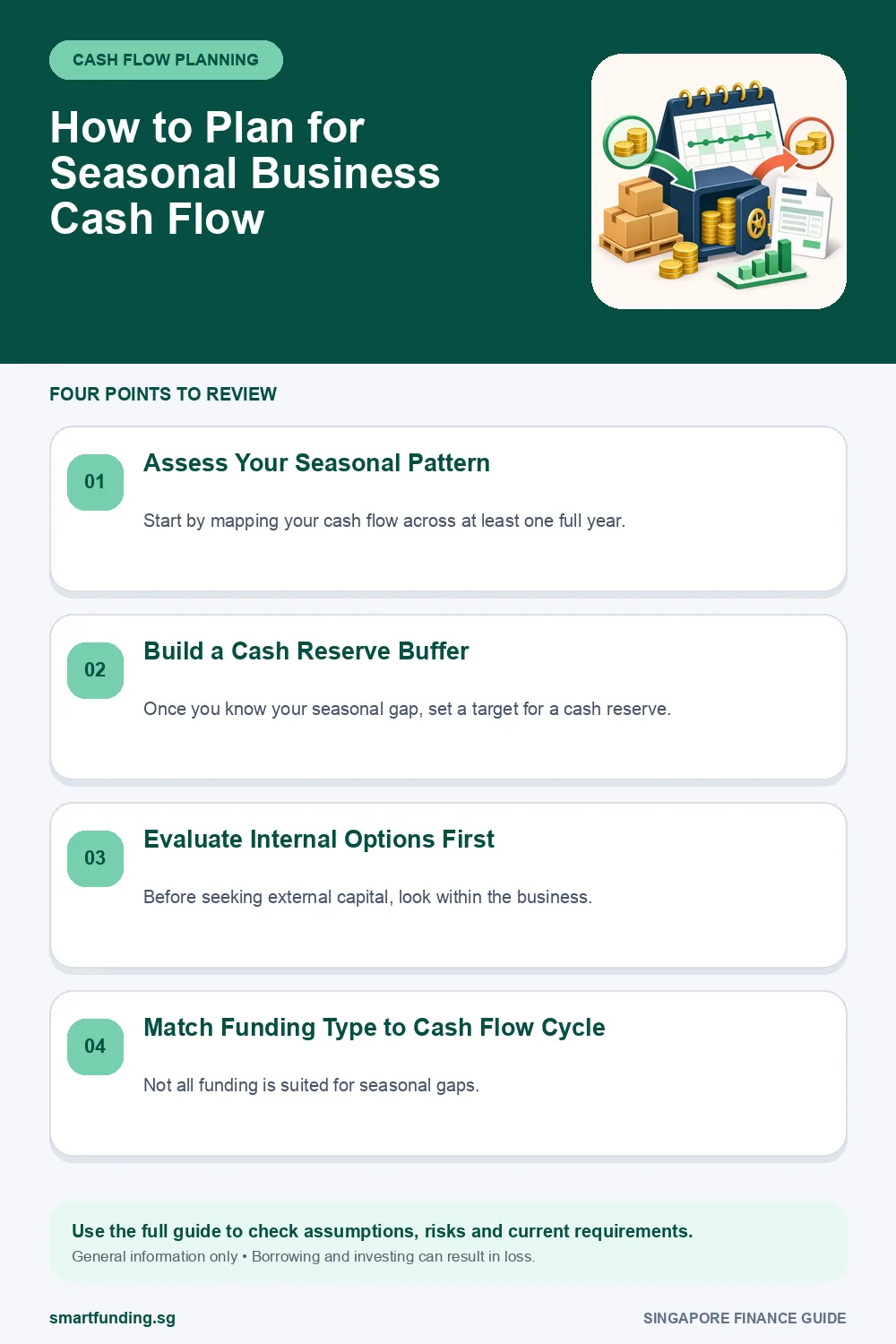
Assess Your Seasonal Pattern
Start by mapping your cash flow across at least one full year. Identify which months revenue peaks and which months it dips. For a Singapore retail business, this might align with the Great Singapore Sale or the Lunar New Year period. For a food supplier, it could be tied to festive seasons. Use accounting software or a simple spreadsheet to track monthly inflows and outflows. The goal is to quantify the gap: how much extra cash you need in lean months and how much surplus you generate in peak months.
Build a Cash Reserve Buffer
Once you know your seasonal gap, set a target for a cash reserve. This is money set aside specifically to cover operating expenses during low-revenue periods. A common benchmark is one to three months of fixed costs, but adjust based on your actual data. Keep this reserve in a separate, easily accessible account. Do not rely on this reserve for growth investments; its purpose is survival. If your reserve is insufficient, you may need to consider external funding.
Evaluate Internal Options First
Before seeking external capital, look within the business. Can you negotiate longer payment terms with suppliers? Can you offer early payment discounts to customers? Can you defer non-essential spending? For Singapore businesses, consider whether you can use the sme-funding-signs-you-need-to-borrow-funds as a checklist to see if internal options are exhausted. If you still have a gap, then explore external funding.
Match Funding Type to Cash Flow Cycle
Not all funding is suited for seasonal gaps. Short-term working capital solutions are often better than long-term loans. For example, invoice-financing-in-singapore can be effective if your peak sales generate invoices with 30- to 60-day payment terms. You can draw against those invoices to smooth cash flow. Alternatively, a revolving credit line allows you to borrow only when needed and repay when cash comes in. Avoid taking a large term loan for a short-term seasonal gap, as the fixed repayments may strain your cash flow in lean months.
Consider Business Capital Solutions
If your seasonal pattern is predictable and you need a larger amount for inventory or equipment ahead of a peak season, business-capital-solutions might be relevant. These can include structured loans or asset-based financing. However, ensure the repayment schedule aligns with your cash flow. For example, if you borrow in June to stock up for a December peak, the repayment should ideally start after December. Discuss with your lender or financial advisor to structure the loan appropriately. Remember that borrowing involves cost and risk; assess whether the expected revenue from the peak season will cover the loan repayments and still leave a profit.
Plan for Tax and Regulatory Obligations
In Singapore, seasonal cash flow planning must account for tax payments such as corporate income tax (estimated or actual) and GST. These are not flexible. If your lean months coincide with a tax deadline, you need cash set aside. Check the IRAS website for payment schedules and consider setting up a separate tax reserve account. Also, if you hire seasonal workers, ensure compliance with MOM regulations on foreign worker levies and CPF contributions. Verify all current rules at the official source, as schemes can change.
Stress Test Your Plan
Run scenarios: what if the peak season is weaker than expected? What if a major customer delays payment? What if a supplier raises prices? Test your cash flow plan against these shocks. Ensure you have a backup funding source, such as an undrawn credit line or a personal guarantee from directors (with clear terms and risk acknowledgment). If the plan fails under a reasonable stress scenario, go back and adjust your reserve target or funding structure.
Frequently asked questions
What is the first step to manage seasonal cash flow
The first step is to map your actual cash flow over at least 12 months. Identify the months with deficits and surpluses. Without this data, any plan is guesswork.
Can invoice financing help with seasonal gaps
Yes, if your business issues invoices during peak sales periods. Invoice financing lets you draw cash against those invoices before they are paid, smoothing the gap until payment arrives. Check the terms carefully, as costs vary.
Should I use a long-term loan for a seasonal need
Generally no. Long-term loans have fixed monthly repayments that can strain cash flow in lean months. Short-term or revolving credit is usually more appropriate. If you must use a longer-term product, ensure the repayment schedule is flexible or aligned with your revenue cycle.