SmartFunding insights
How to Find the Cash Conversion Cycle in Your Business
Learn how to calculate your cash conversion cycle in a Singapore SME. A step-by-step guide to measure operating efficiency and decide if external funding is needed.
What the Cash Conversion Cycle Measures
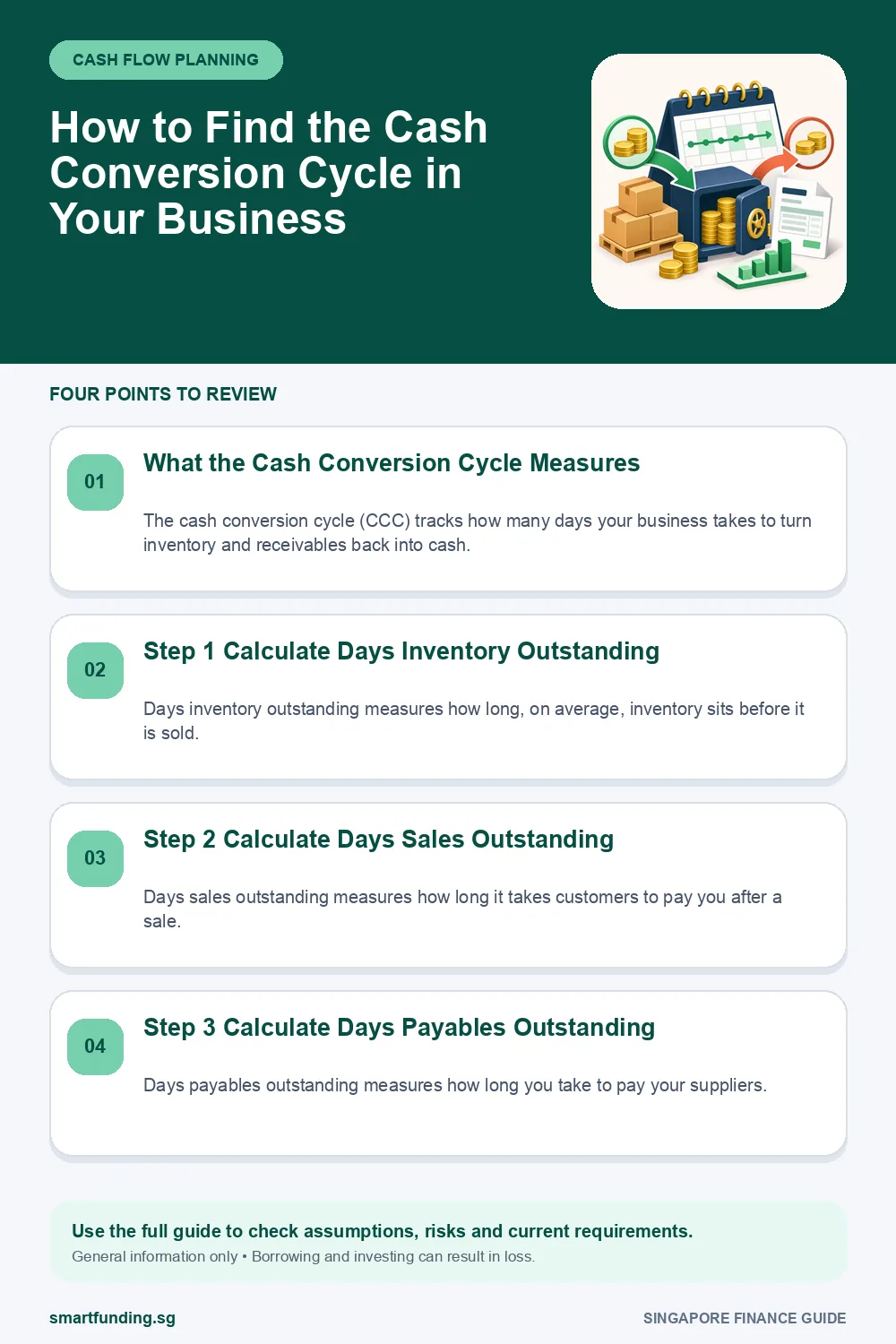
The cash conversion cycle (CCC) tracks how many days your business takes to turn inventory and receivables back into cash. It combines three operating metrics: days inventory outstanding (DIO), days sales outstanding (DSO), and days payables outstanding (DPO). The formula is:
CCC = DIO + DSO – DPO
A shorter cycle means cash is freed faster; a longer cycle signals that working capital is tied up. In Singapore, where operating costs such as rent and wages are high, a stretched CCC can quickly strain cash flow even if your income statement shows a profit.
Step 1 Calculate Days Inventory Outstanding
Days inventory outstanding measures how long, on average, inventory sits before it is sold. Use this formula:
DIO = (Average Inventory / Cost of Goods Sold) × 365
Average inventory is the mean of your opening and closing inventory balances over a period. Cost of goods sold (COGS) is the direct cost of producing the goods you sold in that period.
For a Singapore retailer importing goods, DIO is especially sensitive because holding inventory in a high-cost warehouse or paying for customs storage adds expense. If your DIO exceeds 60 days, examine slow-moving stock and consider whether you are over-ordering to meet minimum order quantities from suppliers.
Step 2 Calculate Days Sales Outstanding
Days sales outstanding measures how long it takes customers to pay you after a sale.
DSO = (Average Accounts Receivable / Total Credit Sales) × 365
Average accounts receivable is the mean of your opening and closing receivable balances. Total credit sales are sales made on credit terms during the period.
In Singapore, payment terms vary by industry. Construction and wholesale trade often run 30 to 60 days, while retail may be immediate. If your DSO is longer than your payment terms, your collections process is weak. A DSO above 45 days in most Singapore SMEs suggests you need to tighten credit policies or consider invoice financing in Singapore to bridge the gap.
Step 3 Calculate Days Payables Outstanding
Days payables outstanding measures how long you take to pay your suppliers.
DPO = (Average Accounts Payable / Total Credit Purchases) × 365
Average accounts payable is the mean of your opening and closing payable balances. Total credit purchases are purchases made on credit terms.
A longer DPO is generally good because it preserves your cash. However, stretching payables beyond agreed terms can damage supplier relationships in Singapore, where business networks are tight. Aim to negotiate standard terms of 30 to 60 days and stick to them. If your DPO is shorter than your DSO, you are paying suppliers before customers pay you, creating a cash gap.
Step 4 Interpret Your Cash Conversion Cycle
Once you have the three components, compute:
CCC = DIO + DSO – DPO
A positive CCC means cash is tied up in operations. For example, if DIO is 40 days, DSO is 45 days, and DPO is 30 days, your CCC is 55 days. That means you need to fund 55 days of operations from sources other than customer payments.
A negative CCC means you are collecting cash before paying suppliers, which is rare for most SMEs. If your CCC is above 60 days, you likely need external funding to cover operating expenses. Review your inventory turnover and credit terms first. If those are already optimised, consider business capital solutions that match your cycle length.
Step 5 Decide Whether to Borrow or Adjust Operations
Use your CCC to decide your next step.
- CCC below 30 days: Your operations are efficient. Focus on maintaining terms and monitoring for sudden changes.
- CCC between 30 and 60 days: You have moderate cash tied up. Look for small operational fixes: offer discounts for early payment, reduce slow-moving inventory, or renegotiate supplier terms.
- CCC above 60 days: Your cash cycle is long. Before borrowing, confirm that the gap is structural, not a one-time event. If it is structural, assess whether you can shorten it by changing payment terms or inventory management. If not, borrowing may be appropriate.
When you consider borrowing, check the signs that your business genuinely needs funds. Read about SME funding signs you need to borrow funds to distinguish between a cash flow gap and a deeper issue. Borrowing to cover a long CCC can be a reasonable solution, but only if you have a clear repayment plan and the loan does not exceed what your cash flow can service.
Step 6 Monitor the Cycle Regularly
Calculate your CCC quarterly at a minimum. Use the same method each time to compare trends. A rising CCC may indicate worsening inventory management or slower collections. A falling CCC shows improvement.
In Singapore, the Monetary Authority of Singapore (MAS) and Enterprise Singapore provide resources on financial management. However, specific regulations and schemes can change. Verify current details at the relevant official source, such as MAS or Enterprise Singapore, before relying on any programme.
Also note that borrowing and investing carry risks. Ensure you can afford repayments even if sales drop. Do not assume approval or guaranteed returns. Every funding decision should be based on your actual cash cycle, not on optimistic projections.
Frequently asked questions
How often should I calculate my cash conversion cycle?
Calculate it at least once every quarter. If your business experiences seasonal fluctuations, compute it monthly during peak and off-peak periods to see how the cycle changes. Consistent tracking helps you spot problems early.
What is a good cash conversion cycle for a Singapore SME?
There is no fixed benchmark that applies to all businesses. A good cycle depends on your industry, payment norms, and inventory turnover. In general, a cycle below 30 days is efficient, while above 60 days may require action. Compare your cycle to your own historical averages rather than an external target.
Can I shorten my cash conversion cycle without borrowing?
Yes. You can reduce DIO by improving inventory turnover, reduce DSO by tightening credit terms and following up on overdue invoices, and extend DPO by negotiating longer payment terms with suppliers. These operational changes often improve cash flow without adding debt. If they are insufficient, then consider external funding.