SmartFunding insights
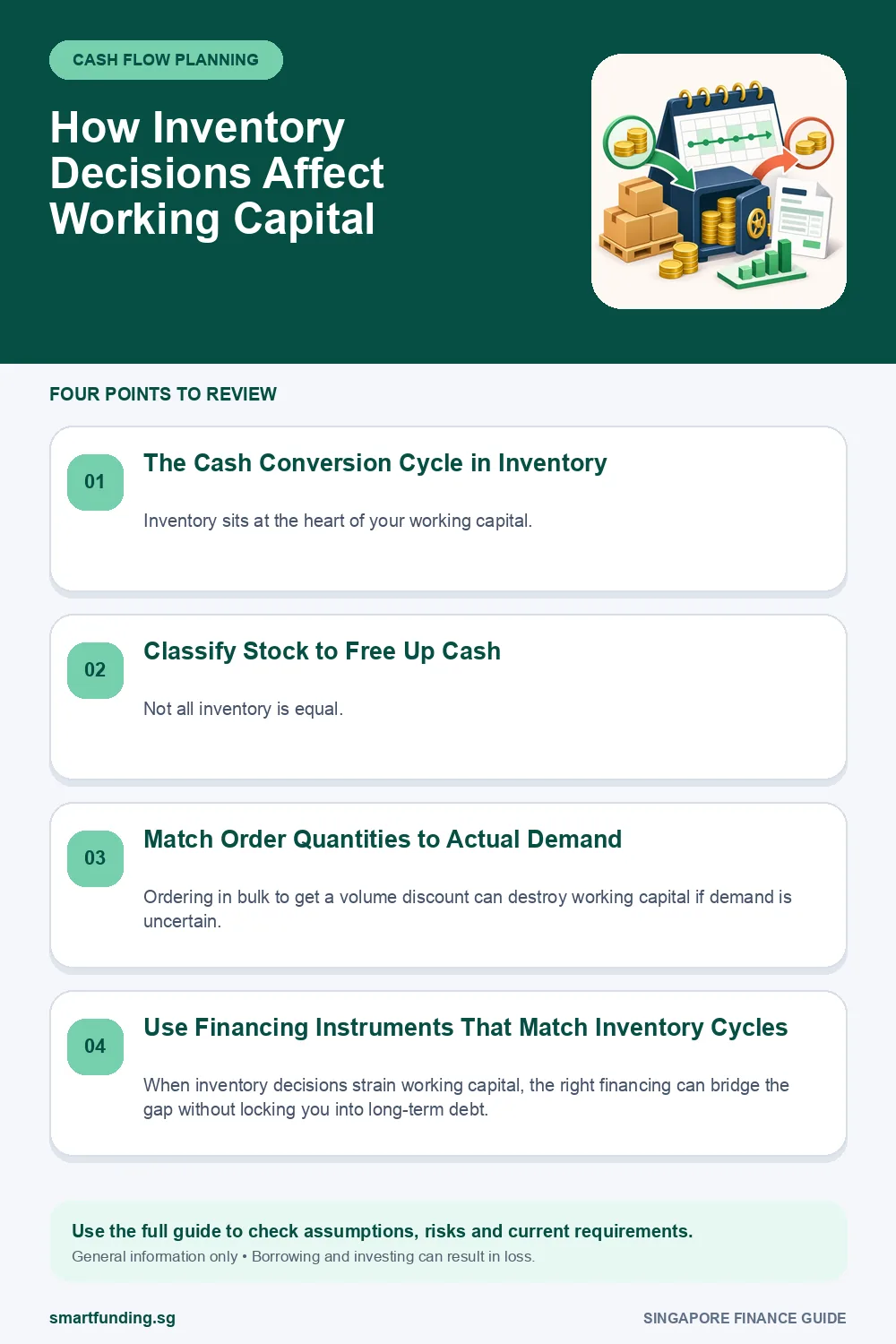
How Inventory Decisions Affect Working Capital
Learn how inventory decisions directly impact working capital in Singapore. A practical guide to optimise stock levels, improve cash flow, and make informed financing choices.
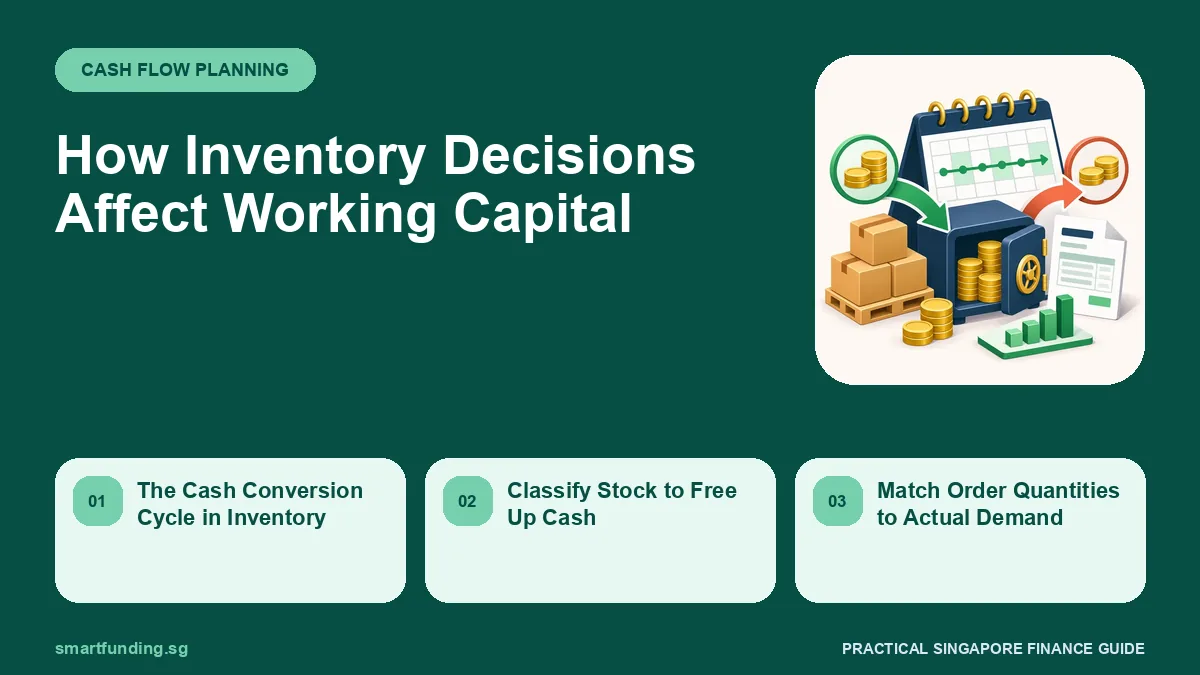
The Cash Conversion Cycle in Inventory
Inventory sits at the heart of your working capital. Every dollar tied up in stock is a dollar not available for payroll, rent or supplier payments. In Singapore, where storage costs are high and demand patterns shift quickly, the speed at which you convert inventory into cash matters more than the gross margin on each item. Your cash conversion cycle starts when you pay for raw materials or finished goods and ends when a customer pays you. The longer that cycle, the more working capital you consume. A practical way to measure this is to track your inventory turnover ratio: cost of goods sold divided by average inventory value. A low ratio signals that stock is sitting too long, draining cash that could otherwise support growth.
Classify Stock to Free Up Cash
Not all inventory is equal. Use a simple ABC classification based on sales velocity and margin. A-items are your fastest-moving, highest-margin products. B-items move steadily but carry lower margins. C-items are slow movers that often accumulate. For each category, set a maximum stock level expressed in days of forward cover. For A-items, aim for no more than 30 days of cover. For B-items, 45 to 60 days. For C-items, review every quarter and liquidate anything beyond 90 days. This discipline prevents cash from being buried in dead stock. In Singapore, where many businesses import goods, also factor in lead time variability. A supplier that is consistently late forces you to hold more safety stock, which ties up working capital. Negotiate shorter lead times or use a consignment arrangement to shift the inventory burden back to the supplier.
Match Order Quantities to Actual Demand
Ordering in bulk to get a volume discount can destroy working capital if demand is uncertain. Instead of a fixed order quantity, use a periodic review system. At the start of each review period, calculate your reorder point as the sum of expected demand during lead time plus a safety buffer. The safety buffer should be based on the standard deviation of demand, not a guess. Do not use a fixed percentage of your order quantity. If your demand fluctuates more than 20 percent from month to month, reduce your order size and increase order frequency. This may raise per-unit costs slightly but will preserve cash. In Singapore, where just-in-time delivery is feasible due to good logistics infrastructure, you can often run with lower safety stock than in less connected markets. Test this by gradually reducing your safety buffer by small increments and monitoring stockout rates.
Use Financing Instruments That Match Inventory Cycles
When inventory decisions strain working capital, the right financing can bridge the gap without locking you into long-term debt. If you have outstanding invoices from customers, consider invoice financing in Singapore to convert those receivables into immediate cash. This is especially useful if you sell to large buyers who take 60 to 90 days to pay. The cash released can be used to replenish fast-moving inventory without waiting for payment cycles to complete. For more general working capital needs, explore SME funding signs you need to borrow funds to identify whether your inventory turnover ratio or payment terms are the root cause of cash tightness. If you need a flexible facility that can be drawn down as inventory needs arise, look at business capital solutions that offer revolving credit lines. Always match the repayment schedule to your inventory turnover cycle. Do not use a long-term loan to finance short-term stock.
Monitor Inventory Age and Write-Down Policy
Inventory that sits unsold for more than six months in Singapore’s humid climate may suffer physical deterioration or obsolescence. Set a policy to mark down slow-moving stock by a fixed amount each month after a certain age. For example, reduce the carrying value by a defined percentage after three months, and again after six months. This forces a realistic view of your working capital position. If you do not write down aged inventory, your balance sheet overstates your asset value and your working capital ratio looks healthier than it really is. That can lead to poor decisions, such as ordering more of a slow mover because the gross margin appears attractive. In Singapore, where consumer tastes change rapidly and seasonal goods have short windows, a disciplined write-down policy is essential. Review your inventory age report at least monthly and flag any item that has not turned within 45 days.
Integrate Inventory Decisions with Supplier Payment Terms
Your inventory decisions do not exist in isolation. They interact directly with the payment terms you negotiate with suppliers. If you order large quantities infrequently, you may get longer payment terms, but you also tie up more cash in storage. Conversely, frequent small orders reduce inventory but may require faster payment. Find the balance by calculating your net working capital benefit for each ordering pattern. The formula is: (average inventory value multiplied by holding cost rate) plus (average payment period multiplied by cost of capital). Choose the pattern that minimises this total. In Singapore, many suppliers offer early payment discounts. If the discount is larger than your cost of capital, take it. If not, stretch the payment terms to preserve cash. Always confirm the exact terms in writing and verify any regulatory requirements with the relevant official source, such as Enterprise Singapore or ACRA, as trade credit rules can change.
Frequently Asked Questions
How do I calculate my optimal inventory level for working capital
Start by estimating your average monthly demand and your supplier lead time in days. Multiply average daily demand by lead time to get your pipeline stock. Add a safety buffer equal to a multiple of the standard deviation of demand. That multiple depends on your desired service level. For most Singapore SMEs, a multiple of 1.5 to 2 works well. The sum of pipeline stock and safety buffer is your optimal maximum inventory. Do not exceed this level without a clear reason.
What financing option works best when inventory is growing faster than sales
If inventory is growing faster than sales, you likely have a demand forecasting issue, not just a cash problem. First, slow down ordering and liquidate slow movers. Then consider a revolving credit facility that you can draw down only when you need to restock fast-moving items. Invoice financing can also help if your receivables are healthy. Avoid term loans for inventory growth because they add fixed repayment pressure that may not align with your sales cycle.
Should I use a trade credit insurance to protect working capital
Trade credit insurance can protect your receivables, which indirectly supports working capital by reducing the risk of bad debts. However, it adds a cost. Evaluate whether your customer concentration or payment history justifies the premium. In Singapore, some insurers offer policies tailored to SMEs. Verify the latest regulatory guidelines from MAS before purchasing. Insurance does not replace good inventory management; it only mitigates one specific risk.