SmartFunding insights
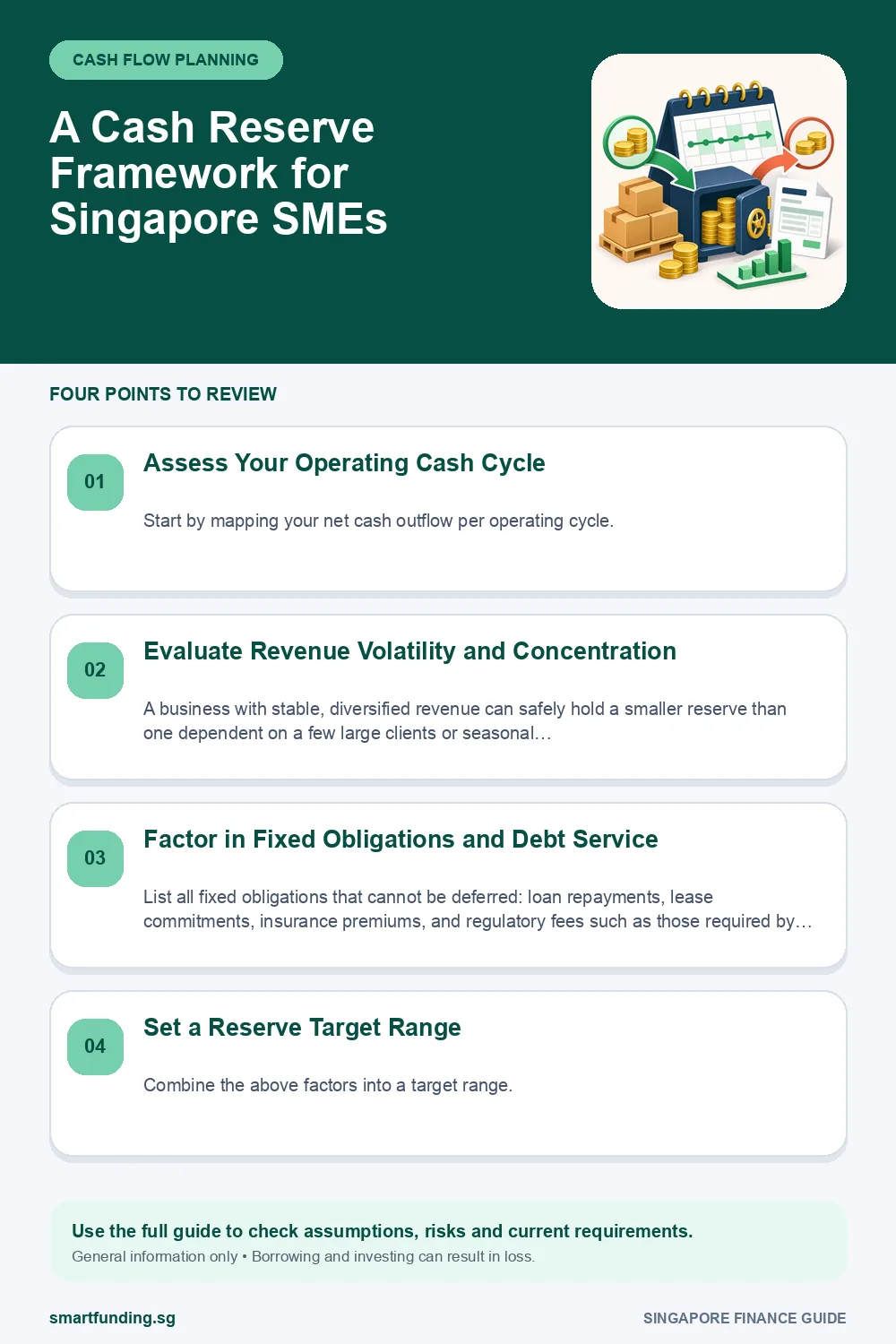
A Cash Reserve Framework for Singapore SMEs
A practical decision framework for Singapore SMEs to determine optimal cash reserves, balancing liquidity, growth funding, and risk management.
Cash reserves are the lifeblood of any small or medium enterprise. In Singapore’s high-cost, open economy, holding too little cash risks insolvency during a downturn, while holding too much may starve growth. This framework provides a structured decision process—not generic motivation—to help you determine the right reserve level for your business.
Assess Your Operating Cash Cycle
Start by mapping your net cash outflow per operating cycle. Identify your average monthly cash expenses: rent, salaries, supplier payments, utilities, and other recurring costs. Then determine the typical time between paying for inputs and receiving payment from customers. In Singapore, where payment terms often range from 30 to 90 days, this gap can be significant. Multiply your monthly cash expenses by the number of months in your cash-to-cash cycle. The result is your minimum operating reserve—the cash needed to keep the business running without additional revenue.
Evaluate Revenue Volatility and Concentration
A business with stable, diversified revenue can safely hold a smaller reserve than one dependent on a few large clients or seasonal spikes. Review your revenue over the past 12 to 24 months. Calculate the coefficient of variation (standard deviation divided by mean) of monthly revenue. If this value is high, increase your reserve target. Also consider client concentration: if your top three customers account for more than half of revenue, add a buffer equivalent to one to two months of operating costs. Singapore’s export-oriented SMEs face additional currency and demand volatility; factor that into your buffer.
Factor in Fixed Obligations and Debt Service
List all fixed obligations that cannot be deferred: loan repayments, lease commitments, insurance premiums, and regulatory fees such as those required by ACRA or IRAS. Sum these over a rolling 12-month period and divide by 12 to get a monthly fixed obligation amount. Your reserve should cover at least three months of these obligations, even if revenue drops. If you have variable-rate loans, stress-test your reserve against a potential interest rate increase of, say, two percentage points. Singapore’s floating-rate loans are tied to benchmark rates that can rise quickly.
Set a Reserve Target Range
Combine the above factors into a target range. A common heuristic for Singapore SMEs is:
- Minimum reserve = 3 months of operating cash cycle costs plus 3 months of fixed obligations.
- Comfortable reserve = 6 months of operating cash cycle costs plus 6 months of fixed obligations.
- Aggressive growth reserve = 2 months of operating cash cycle costs plus 1 month of fixed obligations (only if you have reliable access to short-term funding).
Use your revenue volatility and client concentration to adjust within this range. For example, a stable service firm with diversified clients might target the lower end, while a manufacturer with long payment cycles and concentrated buyers should aim for the comfortable reserve.
Identify Funding Gaps and Bridging Options
Once you have a target reserve, compare it to your current cash position. If there is a shortfall, do not simply cut expenses—consider funding options that preserve liquidity. For instance, if you have unpaid invoices, invoice financing in Singapore can convert receivables into cash without taking on new debt. If you need a lump sum for a growth opportunity, explore business capital solutions that match your repayment capacity. Always assess the cost of funding against the cost of holding insufficient reserves. Borrowing can cause loss if you cannot service the debt; ensure you have a clear repayment plan.
Monitor and Adjust Regularly
Your reserve target is not static. Review it quarterly or whenever you experience a significant change: a new large contract, loss of a major client, change in payment terms, or shift in Singapore’s economic outlook. Use a simple spreadsheet to track actual cash against target. If you consistently exceed the comfortable reserve, consider deploying excess cash into growth initiatives or reducing debt. If you dip below minimum reserve, take immediate action—cut discretionary spending, negotiate longer payment terms with suppliers, or seek funding. Do not wait for a crisis.
Frequently asked questions
What is the difference between cash reserves and working capital?
Cash reserves are idle cash held for emergencies or opportunities, while working capital is cash used to fund day-to-day operations. Your reserve is a subset of your total cash position that you deliberately keep unallocated. Working capital fluctuates with your operating cycle; reserves should remain stable unless drawn down.
How do I know if I have too much cash in reserves?
If your cash reserves consistently exceed your comfortable target by more than 20 percent for two consecutive quarters, you likely have excess. Compare the return on holding that cash (zero) to the return you could earn by investing in growth, paying down expensive debt, or distributing to shareholders. Remember that investing can cause loss; assess affordability and risk before deploying excess cash.
Should I use a line of credit instead of holding cash reserves?
A line of credit can supplement reserves but should not replace them entirely. Lines can be reduced or cancelled by the lender, especially during a downturn. Singapore’s banks may tighten credit when the economy weakens. Maintain a baseline cash reserve that covers at least two months of fixed obligations, then use credit for larger, unexpected needs. For short-term cash flow gaps, consider sme funding signs you need to borrow funds to evaluate whether borrowing is appropriate. Always verify current lending terms and conditions with your financial institution.
Note: All schemes, tax treatments, regulations, and licensing requirements mentioned are subject to change. Verify current details with the relevant official Singapore source: Monetary Authority of Singapore (MAS), Enterprise Singapore, Accounting and Corporate Regulatory Authority (ACRA), or Inland Revenue Authority of Singapore (IRAS) as applicable.