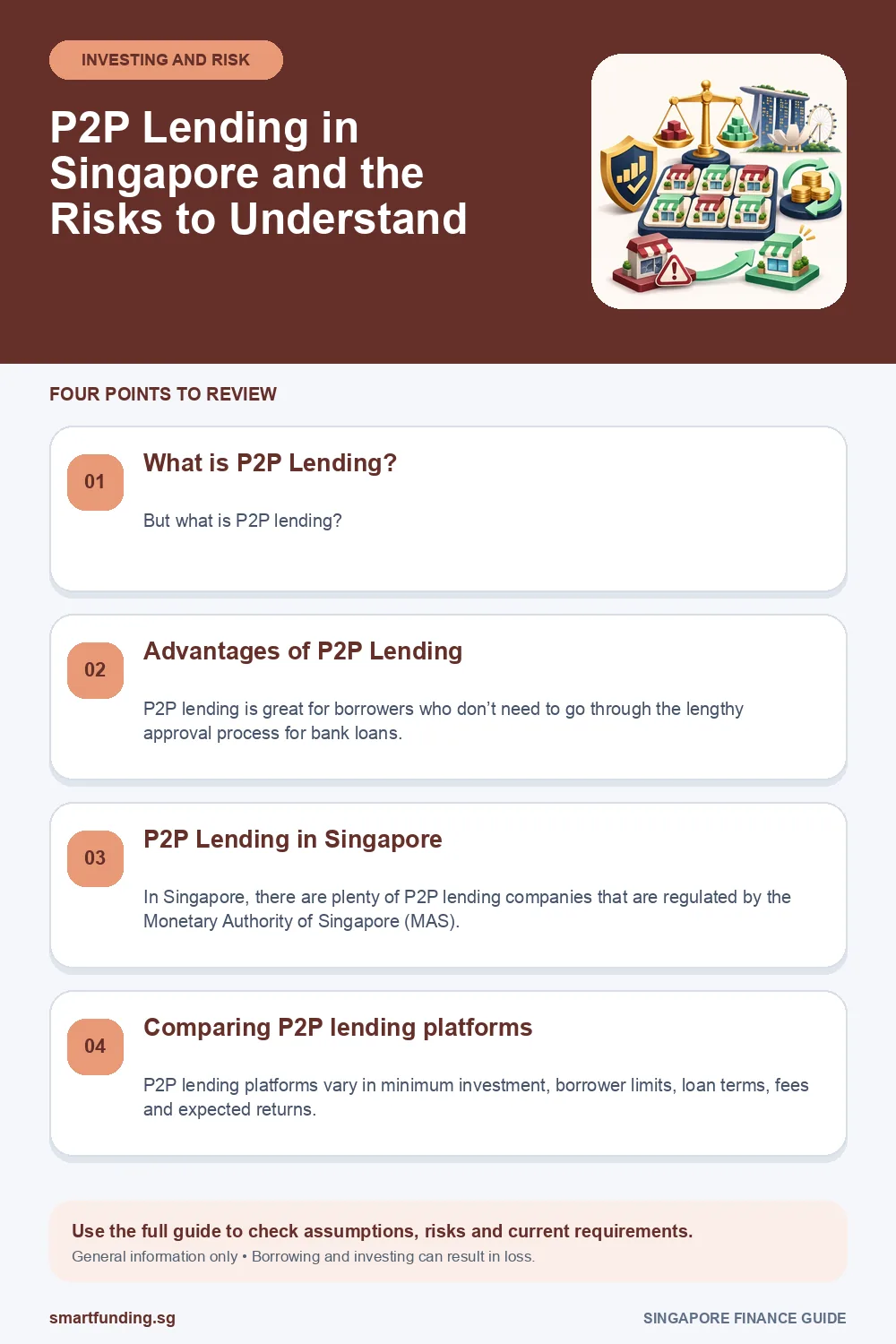
P2P Lending in Singapore and the Risks to Understand
Learn about P2P Lending in Singapore and the Risks to Understand, including practical considerations, key risks and useful questions for Singapore.
Explore more in Investing and Risk

Most of the time, banks, financing companies, and credit unions are the ones offering secured loans to individuals. But the financing schemes offered by these financial institutions usually come with high interest rates.
Which is why P2P lending is quickly becoming a popular choice for business term loans among small and medium-sized enterprises (SMEs). That’s not all, P2P lending also helps to create investment opportunities for budding entrepreneurs.
What is P2P Lending?
But what is P2P lending? For starters, P2P lending stands for Peer-to-Peer lending, also known as crowdlending or social lending. It is a financing method that allows individuals to get secured loans from other individuals directly, without needing a financial institution. In return, the individuals lending the money act as investors who will receive their repayment in interest rates. This makes it another good option for personal finance investment.
Advantages of P2P Lending
P2P lending is great for borrowers who don’t need to go through the lengthy approval process for bank loans. But investors may wonder, why should I invest in P2P lending with all the risks involved? Well, P2P financing is actually a great investment product as it offers high returns of up to 10% and more. It also helps to build the investor’s investment portfolio, allowing them to choose the type of company they want to invest in.
The risks of P2P investment can also be assessed beforehand because investors can view the borrower’s profile and decide which loans they wish to invest in. So if a loan were to default, investors can still enjoy returns from their other investments. All in all, P2P lending offers more investing opportunities and flexibility for investors, and helps to reduce the risks for new investors.
P2P Lending in Singapore
In Singapore, there are plenty of P2P lending companies that are regulated by the Monetary Authority of Singapore (MAS). Depending on the P2P platform, investors can make their investment based on the different interest rates, default rates, and minimum investment amount offered by each company.
Comparing P2P lending platforms
P2P lending platforms vary in minimum investment, borrower limits, loan terms, fees and expected returns. Compare these features only after checking licensing, default data and risk disclosures.
Eligibility and onboarding requirements vary by provider. Investors may need identity, bank and suitability information before accessing any opportunities.
Some platforms include term loans, invoice finance or procurement finance. Each structure creates different cash-flow, credit and recovery risks.
Choose investments according to risk tolerance, liquidity needs and portfolio concentration rather than the number of products available.
Source 1 , 2 , 3 , 4