SmartFunding insights
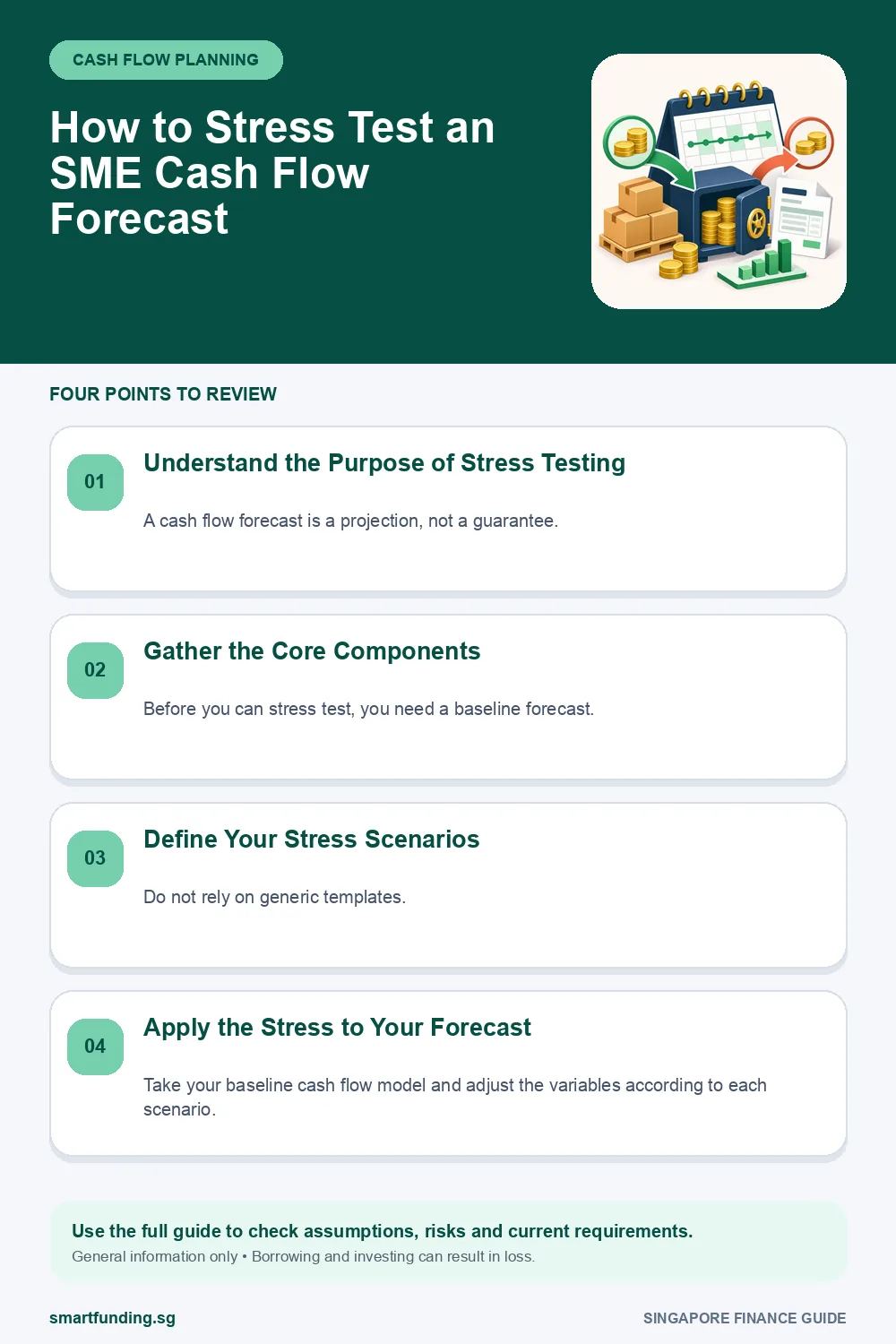
How to Stress Test an SME Cash Flow Forecast
A step-by-step guide to stress testing an SME cash flow forecast in Singapore. Learn to assess liquidity, identify risks, and make informed borrowing decisions.
Understand the Purpose of Stress Testing
A cash flow forecast is a projection, not a guarantee. Stress testing means deliberately applying adverse scenarios to see if the business can still meet its obligations. For a Singapore SME, this is especially important because of the city-state’s unique cost structure, including high rental and labour costs, and the reliance on short-term trade credit. The goal is not to predict the future but to identify the weakest points in your cash flow so you can strengthen them before a real crisis hits.
Gather the Core Components
Before you can stress test, you need a baseline forecast. This should include: - Projected revenue from confirmed orders and repeat business - Expected timing of collections (e.g., net 30, 60, or 90 days) - Fixed costs such as rent, salaries, and insurance - Variable costs like raw materials, utilities, and logistics - Debt service payments, including principal and interest on any existing loans - Tax obligations, including GST and corporate income tax
In Singapore, it is also wise to include the cost of complying with ACRA filing requirements and any industry-specific licences. Verify current regulatory obligations at the relevant official source, such as ACRA or IRAS, as these can change.
Define Your Stress Scenarios
Do not rely on generic templates. Create scenarios that reflect real risks your SME faces. Common ones include: - A major customer delays payment by 60 days - A key supplier raises prices by a significant margin - A sudden drop in sales due to a competitor’s move or a market downturn - An unexpected expense such as equipment breakdown or a regulatory fine - A tightening of credit terms by your bank or trade partners
For each scenario, define the variable that changes (e.g., collection days, cost of goods sold, revenue amount) and apply it to your forecast. Do not use a numerical percentage or currency amount; instead, describe the change in relative terms, such as “a moderate increase in supplier costs” or “a significant delay in customer payments.”
Apply the Stress to Your Forecast
Take your baseline cash flow model and adjust the variables according to each scenario. For example, if you are testing a payment delay, shift the receipt of a large invoice by a certain number of days. If you are testing a cost increase, add a reasonable uplift to your variable costs. The key is to model the impact on your cash balance at the end of each month.
Calculate the resulting cash shortfall or surplus. If the shortfall exceeds your available reserves or undrawn credit lines, you have identified a vulnerability. Do not assume you can always borrow your way out; borrowing costs money and may not be available when you need it most. Assess the affordability of any potential loan by considering whether the business can service the additional debt even under the stressed scenario.
Interpret the Results and Identify Triggers
Once you have run several scenarios, look for patterns. If a single late payment sinks the business, that is a red flag. If a cost increase of a certain magnitude causes a cash crunch, you know the threshold to watch. Define early warning triggers: for example, if your cash balance falls below a certain level, you will take pre-emptive action such as cutting discretionary spending or negotiating extended payment terms with suppliers.
In Singapore, where many SMEs operate on thin margins due to high operating costs, even a small shock can be amplified. Consider whether you have access to alternative funding sources, such as invoice financing in Singapore, which can convert unpaid invoices into immediate cash. However, remember that financing is not a cure for a fundamentally weak business model.
Build a Contingency Plan
Based on your stress test results, create a concrete plan for each scenario. This plan should specify: - The exact action you will take (e.g., draw down a pre-arranged credit line, delay a non-essential capital purchase, or approach a customer for early payment) - The person responsible for executing the action - The timeline for implementation
If your stress test shows you will need external funds, explore options like business capital solutions that match your needs. But be realistic: borrowing can lead to loss if the business cannot repay. Ensure you have a clear repayment plan that does not depend on optimistic revenue assumptions.
Monitor and Update Regularly
A stress test is not a one-time exercise. Update your forecast and re-run scenarios whenever your business environment changes: a new contract, a change in supplier terms, or a shift in economic conditions. In Singapore, keep an eye on official sources such as Enterprise Singapore for grants or schemes that might affect your cash flow, but verify current details as they can change.
Frequently asked questions
What is the simplest way to start stress testing without a financial model?
Use a spreadsheet with your actual bank statements from the past six months. List all expected inflows and outflows for the next three months. Then manually shift one major inflow by a few weeks and see if the ending balance goes negative. That is a basic stress test. As you get comfortable, add more variables.
How much cash reserve should an SME in Singapore keep?
There is no fixed rule. A common guideline is to have enough cash to cover three to six months of fixed operating expenses. However, the right amount depends on your industry, customer payment patterns, and access to credit. Stress testing your own forecast will give you a more tailored answer. If your stress test shows you need more buffer, consider whether you can build it through retained profits or a cautious use of sme funding signs you need to borrow funds.
Should I include GST in my cash flow forecast?
Yes. In Singapore, GST is a pass-through tax, but the timing of collections and payments can create cash flow mismatches. If you collect GST from customers but pay it to IRAS quarterly, you may have a temporary cash benefit or shortfall. Include GST in your forecast as a separate line item, and check IRAS for current rules on GST filing and payment deadlines, as these can change.