SmartFunding insights
How to Prioritise Payments During a Cash Squeeze
A practical Singapore-focused guide to prioritising payments when cash is tight, using a clear decision process without generic motivation.
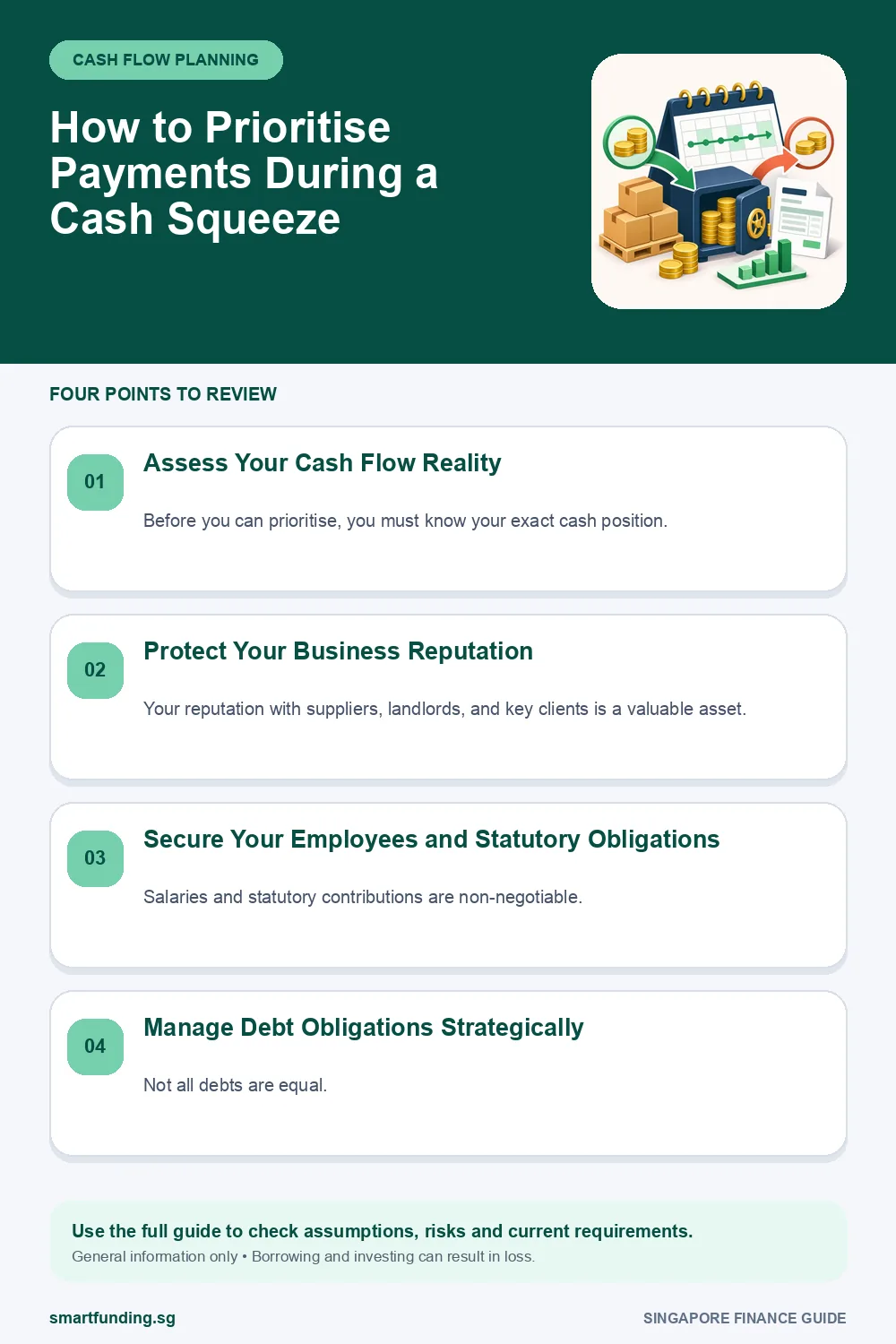
Assess Your Cash Flow Reality
Before you can prioritise, you must know your exact cash position. List all income expected in the next four weeks and every payment due in the same period. In Singapore, this includes recurring obligations such as Central Provident Fund (CPF) contributions for employees, Goods and Services Tax (GST) payments to IRAS, and any hire-purchase instalments. Separate essential business costs like rent, salaries, and raw materials from discretionary spending. Do not guess. Use your bank statements and accounting software to get a clear picture. If you are unsure about your obligations, check the official IRAS website for current GST and tax payment deadlines.
Protect Your Business Reputation
Your reputation with suppliers, landlords, and key clients is a valuable asset. In Singapore’s close-knit business community, a single default can quickly spread. Prioritise payments that, if missed, would immediately damage your ability to operate. This includes rent for your premises, utility bills (to avoid disconnection), and payments to critical suppliers who provide essential inventory or services. If you cannot pay a supplier in full, contact them early to propose a partial payment or an extended timeline. Many Singapore businesses are open to negotiation if you communicate honestly before the due date.
Secure Your Employees and Statutory Obligations
Salaries and statutory contributions are non-negotiable. In Singapore, failing to pay salaries on time can lead to Ministry of Manpower (MOM) complaints and damage your ability to retain staff. Similarly, CPF contributions and Skills Development Levy must be paid according to schedule. Non-payment can result in penalties and interest charges from the relevant authorities. Always prioritise these payments above all others, except perhaps for critical supplies that keep your business running. If cash is extremely tight, consider speaking with your employees about a temporary deferral of a portion of their salary, but only as a last resort and with full transparency.
Manage Debt Obligations Strategically
Not all debts are equal. Prioritise secured debts (such as bank loans backed by collateral) over unsecured ones, because default could lead to asset seizure. Next, focus on debts with the highest effective interest rates or penalties for late payment. In Singapore, credit card debts and unsecured personal loans often carry high interest. If you have multiple debts, consider consolidating them or negotiating with creditors for a revised payment plan. For businesses needing short-term funds, invoice financing in Singapore can unlock cash tied up in unpaid invoices, allowing you to meet urgent obligations without taking on new debt. However, remember that borrowing always carries risk; ensure you can afford the repayments before proceeding.
Evaluate Funding Options Carefully
If your cash squeeze is temporary and you have a clear path to recovery, external funding can bridge the gap. Look first at your existing assets. Can you sell slow-moving inventory? Can you negotiate longer payment terms with your own customers? If not, consider a business loan or a line of credit. Before applying, read about SME funding signs you need to borrow funds to ensure you are not borrowing for the wrong reasons. Also explore business capital solutions that might suit your situation. Remember that all borrowing involves costs and risks. Do not borrow if you cannot see a clear way to repay. Interest rates and terms vary, so compare offers from multiple lenders. Check with Enterprise Singapore for any grants or schemes that might support your industry, but be aware that such schemes can change or end without notice.
Cut Costs Before Cutting Payments
Before you delay any payment, review your expenses for immediate savings. Cancel non-essential subscriptions, renegotiate contracts with vendors, and reduce discretionary spending. In Singapore, this might include pausing marketing campaigns, reducing office space, or deferring non-urgent equipment purchases. Every dollar saved is a dollar you can use to meet essential obligations. If you must delay a payment, choose the one with the least severe consequence. For example, a late payment to a non-critical supplier may be less damaging than missing a tax deadline.
Communicate Proactively with All Stakeholders
If you anticipate missing a payment, inform the affected party before the due date. Provide a realistic timeline for when you expect to pay. In Singapore’s business culture, transparency builds trust. Most creditors prefer a partial payment on time to a full payment late. Document all agreements in writing. If you are dealing with a government agency such as IRAS or MOM, check their official website for any relief options or instalment plans. Do not assume relief is available; verify directly.
Frequently asked questions
What should I pay first when cash is tight?
Prioritise payments that keep your business operating and avoid immediate legal or reputational damage. This typically means salaries, statutory contributions (CPF, taxes), rent, and critical supplier payments. Next, address secured debts and high-interest obligations. Always communicate with creditors early if you foresee a delay.
Can I use invoice financing to solve a cash squeeze?
Invoice financing can be a useful tool if you have unpaid invoices from creditworthy customers. It provides immediate cash without adding long-term debt, but it comes with fees and requires that your customers pay eventually. Assess whether the cost is worth the benefit and whether you can manage the repayment. For more details, see the section on invoice financing in Singapore.
Where can I verify current tax or regulatory payment deadlines?
Always check the official website of the relevant authority. For corporate tax and GST, visit IRAS. For CPF contributions, check the CPF Board website. For employment regulations, refer to MOM. For business grants, go to Enterprise Singapore. Rules and deadlines can change, so do not rely on third-party summaries.