SmartFunding insights
How to Prepare for a Business Loan Application
A practical Singapore-focused guide to preparing a business loan application, covering key documents, financial health, and lender selection.
Understand Your Borrowing Needs
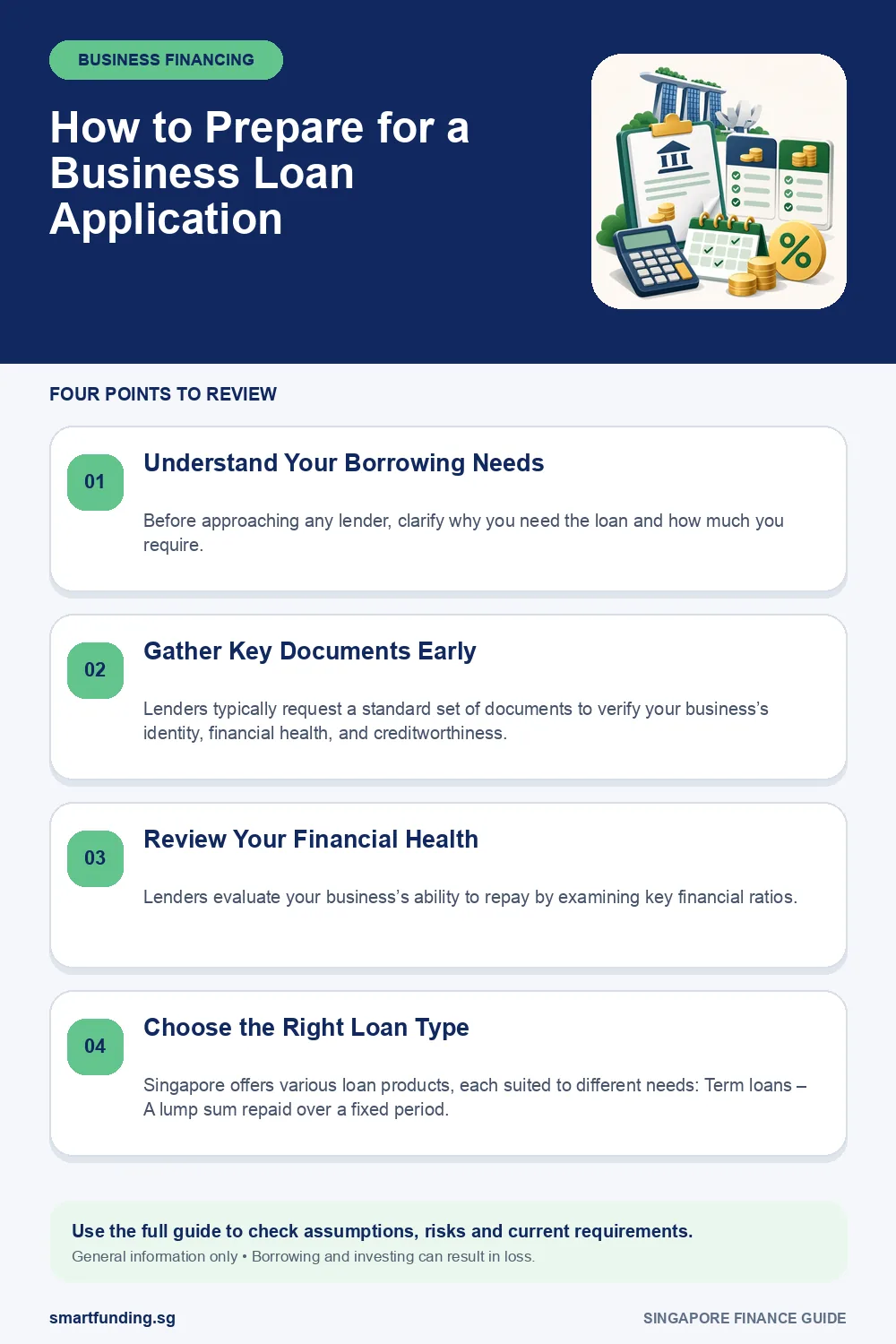
Before approaching any lender, clarify why you need the loan and how much you require. Calculate the exact shortfall in your cash flow or the precise cost of the asset or project you intend to fund. Avoid borrowing more than necessary, as excess debt increases repayment pressure. For Singapore SMEs, common purposes include bridging payment gaps, purchasing equipment, or financing stock for seasonal demand. Review your business plan to ensure the loan will generate sufficient returns to cover principal and interest. Remember that borrowing carries risk: if your revenue does not materialise as expected, you remain liable for repayment. Assess your business’s ability to service debt even under a conservative revenue forecast.
Gather Key Documents Early
Lenders typically request a standard set of documents to verify your business’s identity, financial health, and creditworthiness. Prepare these in advance to speed up the application process:
- Business registration – Your ACRA-issued certificate and latest business profile.
- Financial statements – At least two years of audited or management accounts, including profit-and-loss statements and balance sheets. For newer businesses, provide the most recent six months of bank statements and management accounts.
- Tax filings – Your latest Notice of Assessment from IRAS and corresponding tax returns.
- Bank statements – Six to twelve months of your business’s current account statements showing cash flow patterns.
- Business plan – A concise document outlining your business model, market, revenue projections, and how the loan will be used.
- Personal guarantees – Many lenders require personal guarantees from directors or major shareholders. Understand that this means your personal assets may be at risk if the business defaults.
Keep copies organised and digital-ready. Check the SmartFunding guide on SME financing for a deeper checklist tailored to Singapore enterprises.
Review Your Financial Health
Lenders evaluate your business’s ability to repay by examining key financial ratios. Focus on these areas:
- Debt service coverage ratio (DSCR) – This compares your net operating income to total debt payments. A ratio above 1.2 is generally preferred, but thresholds vary by lender. Calculate yours using your last 12 months of financials.
- Profitability – Consistent gross profit margins and positive net profit indicate a healthy business. If your margins are thin, consider how the loan cost will affect them.
- Cash flow – Lenders want to see regular inflows that cover operating expenses plus the new loan instalment. Use your bank statements to demonstrate a stable cash flow cycle.
- Personal credit score – For sole proprietors and directors, your personal credit report from a credit bureau (e.g., CBS) will be checked. A poor score can derail the application. Obtain your report early and rectify any errors.
If your financials are weak, consider delaying the application until you improve collections, reduce unnecessary expenses, or inject more equity. Borrowing when your business is already strained increases the risk of default and loss.
Choose the Right Loan Type
Singapore offers various loan products, each suited to different needs:
- Term loans – A lump sum repaid over a fixed period. Suitable for asset purchases or long-term investments.
- Working capital loans – Typically revolving or short-term, designed to cover cash flow gaps. Interest may be higher, but repayment is flexible.
- Trade financing – For importers and exporters needing to bridge payment and shipment cycles. Often secured against invoices or inventory.
- Equipment financing – The equipment itself serves as collateral, which can lower interest rates.
- Government-assisted schemes – For example, Enterprise Singapore’s Enterprise Financing Scheme (EFS) or SME Working Capital Loan. These may offer partial risk sharing, making lenders more willing to approve. However, terms and availability change. Always verify current details at the Enterprise Singapore website.
Compare interest rates, fees, repayment tenure, and collateral requirements. Use the SmartFunding financing options page to explore different products and lenders side by side.
Prepare a Strong Application
A complete and clear application increases your chances of approval. Follow these steps:
- Tailor your business plan – Explain how the loan will be used and how it will generate revenue to repay the debt. Be specific: e.g., “Purchase two food trucks to expand delivery capacity, projected to increase monthly revenue by $15,000.”
- Highlight repayment capacity – Show that even after the loan instalment, your business maintains a healthy cash buffer. Include a simple repayment schedule in your proposal.
- Disclose existing debts – Be transparent about other loans. Lenders will check anyway, and hiding liabilities damages trust.
- Provide collateral details – If you are offering property, equipment, or personal guarantees, include valuation or supporting documents.
- Check regulatory requirements – Depending on your industry (e.g., food services, financial advice, healthcare), you may need specific licences or permits. Verify with the relevant authority. For general licensing, refer to ACRA or the Monetary Authority of Singapore for financial services.
Avoid rushing. A sloppy application with missing documents leads to delays or rejection. If you are unsure, consult a business advisor or accountant familiar with Singapore’s lending landscape.
Understand Costs and Risks
Beyond the interest rate, factor in all costs:
- Processing fees – Some lenders charge a flat fee or a percentage of the loan amount.
- Late payment penalties – Know the grace period and penalty rate.
- Early repayment fees – If you plan to repay early, check whether a penalty applies.
- Personal guarantees – As noted, these put your personal assets at risk. Consider limiting the guarantee amount or duration if possible.
Borrowing always carries risk. If your business revenue drops, you may struggle to meet repayments, leading to default, legal action, and loss of collateral. Never borrow without a realistic repayment plan. Assess whether your business can absorb a temporary downturn while still servicing the loan.
Frequently asked questions
What documents do Singapore banks typically require for a business loan?
Most lenders ask for your ACRA business registration, two years of financial statements, latest IRAS Notice of Assessment, six months of bank statements, and a business plan. Some may also request personal guarantees and directors’ personal credit reports. Requirements vary, so confirm with your chosen lender. For official guidance on financial reporting, refer to IRAS.
How long does the loan application process take in Singapore?
For a straightforward application with complete documents, approval can take from a few days to two weeks. Government-assisted schemes may take longer due to additional verification. Complex applications or those requiring collateral valuation can extend to four weeks. Prepare your documents in advance to minimise delays.
Can a startup with no profit history get a business loan in Singapore?
It is challenging but possible. Lenders may consider the founder’s personal credit score, collateral, or a strong business plan with realistic projections. Some government schemes like the Startup SG Founder grant or Enterprise Financing Scheme may help, though eligibility criteria apply. Be prepared to provide a personal guarantee and accept higher interest rates. Always verify current scheme details at Enterprise Singapore. For more options, visit the SmartFunding borrow page.