SmartFunding insights
Business Loan Fees Every SME Should Check
Understand the true cost of SME loans in Singapore. This guide breaks down key fees and provides a practical decision process for business owners.
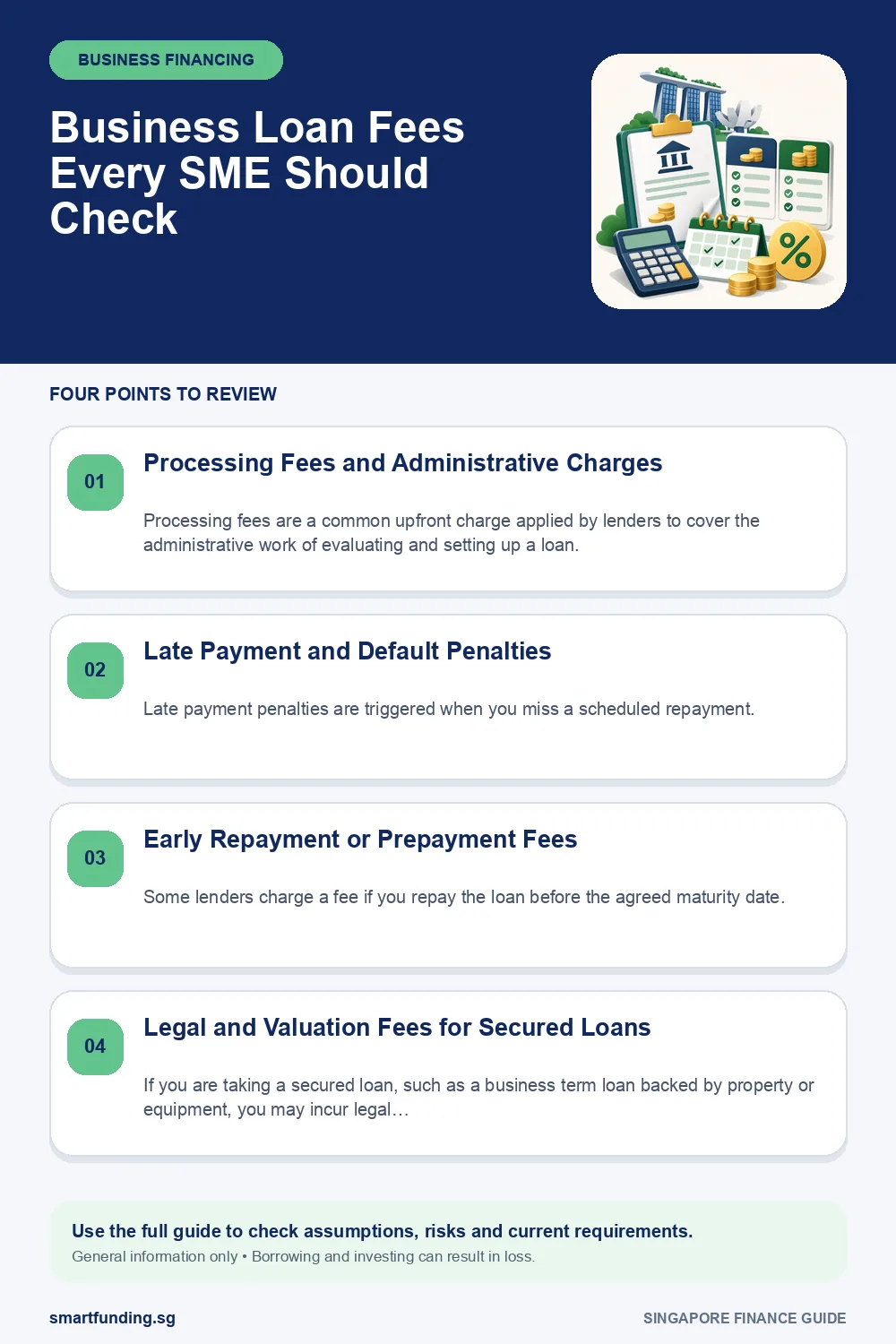
Processing Fees and Administrative Charges
Processing fees are a common upfront charge applied by lenders to cover the administrative work of evaluating and setting up a loan. In Singapore, these fees are typically a percentage of the loan principal. However, the exact percentage can vary between lenders and may be negotiable. Before signing any agreement, ask the lender to clearly state the processing fee as a flat amount or as a percentage of the principal. Also confirm whether this fee is deducted from the disbursed amount or charged separately. A fee deducted from the disbursement reduces the net amount you receive, effectively increasing the cost of borrowing.
Late Payment and Default Penalties
Late payment penalties are triggered when you miss a scheduled repayment. These are often calculated as a percentage of the overdue amount or as a fixed charge per day of delay. Default penalties may apply if the loan is not repaid after a certain period. In Singapore, late payment interest may be capped under certain regulations, but caps can vary by lender and loan type. Always review the loan agreement for the specific penalty calculation method. If you anticipate cash flow challenges, discuss restructuring options with your lender before a payment is missed.
Early Repayment or Prepayment Fees
Some lenders charge a fee if you repay the loan before the agreed maturity date. This compensates the lender for lost interest income. The fee may be a fixed amount or a percentage of the outstanding principal. In Singapore, early repayment fees are more common for term loans than for revolving credit facilities. Before committing to a loan, ask whether an early repayment fee applies and how it is calculated. If you expect to repay early, a loan with no or low prepayment fees may be more cost-effective.
Legal and Valuation Fees for Secured Loans
If you are taking a secured loan, such as a business term loan backed by property or equipment, you may incur legal fees for document preparation and registration of the charge. Valuation fees may also be required to assess the collateral’s value. These fees are typically paid to third-party professionals and are not retained by the lender. In Singapore, legal fees for secured loans are often regulated by the Law Society or subject to guidelines from MAS. Ask the lender for an estimate of these fees and whether they are included in the loan package or charged separately.
Commitment Fees and Undrawn Facility Fees
For revolving credit facilities or overdrafts, some lenders charge a commitment fee on the undrawn portion of the approved limit. This fee compensates the lender for reserving funds that you have not yet used. The fee is usually a small percentage per annum on the undrawn amount. In Singapore, this is more common for larger facilities or when the borrower has a variable drawdown schedule. Check the loan agreement for any commitment fee clause and understand how the undrawn amount is calculated.
Insurance and Ancillary Product Costs
Lenders may require you to purchase insurance, such as fire insurance for secured property or trade credit insurance, as a condition of the loan. While these products protect both the borrower and the lender, they add to the total cost of borrowing. In Singapore, you are not obliged to buy insurance from the lender’s preferred provider if you can source a comparable policy elsewhere. Compare premiums and coverage before agreeing to bundled insurance. Also verify with the lender whether the insurance is a mandatory requirement or optional.
Frequently asked questions
What is the difference between an interest rate and a processing fee
An interest rate is the cost of borrowing expressed as a percentage of the outstanding principal over time. A processing fee is a one-time charge for setting up the loan. The interest rate affects your periodic repayments, while the processing fee is usually paid upfront. Both contribute to the total cost of the loan. Always compare the effective interest rate, which includes both the interest and any upfront fees, to get a true picture of the cost.
Can I negotiate loan fees with a lender in Singapore
Yes, some fees may be negotiable, especially for larger loan amounts or for borrowers with strong credit profiles. Processing fees, early repayment fees, and commitment fees are often negotiable. However, late payment penalties and default charges are typically fixed in the loan agreement. It is advisable to discuss all fees before signing the contract and to get any negotiated terms in writing.
Where can I verify current regulations on business loan fees
You should check the official website of the Monetary Authority of Singapore (MAS) for guidelines on interest rate caps and fee disclosure requirements. Enterprise Singapore provides resources on financing options for SMEs. The Accounting and Corporate Regulatory Authority (ACRA) and the Inland Revenue Authority of Singapore (IRAS) may also have relevant rules for specific loan types. Regulations can change, so always verify at the official source.
For more information on financing options, see our guide on financing options. Before applying, consider seven things to think about for SME financing. If you are ready to proceed, you can explore borrowing.