SmartFunding insights
How to Build a 13 Week Cash Flow Forecast
A practical guide to building a 13-week cash flow forecast for Singapore SMEs, with decision steps and risk awareness.
A 13-week cash flow forecast is a short-term planning tool that helps you see your cash position week by week. For Singapore businesses, this is especially useful because of the city-state’s fast payment cycles, quarterly tax obligations, and the need to manage working capital efficiently. This guide gives you a practical decision process—not generic motivation—so you can build a forecast that helps you act, not just observe.
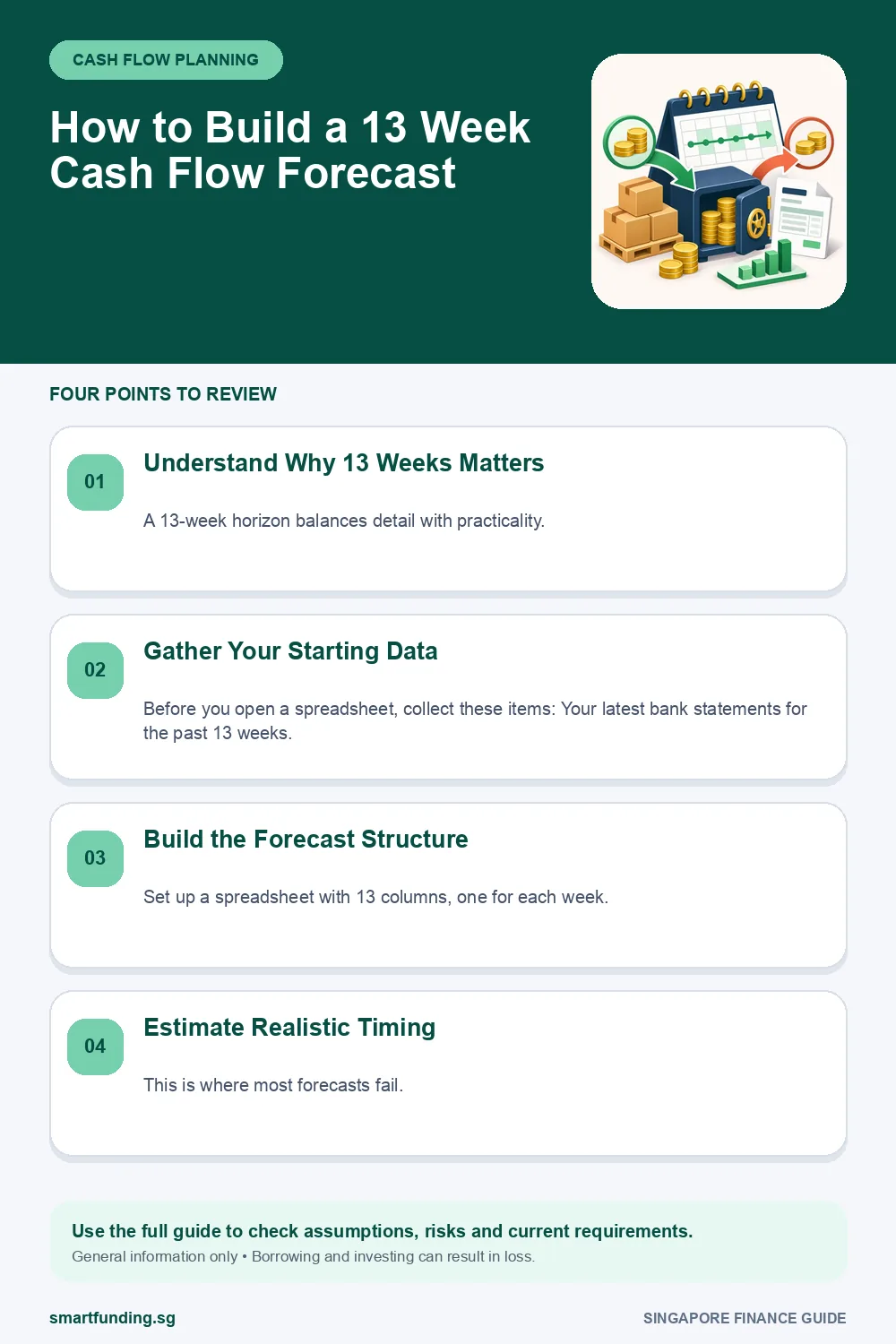
Understand Why 13 Weeks Matters
A 13-week horizon balances detail with practicality. It is long enough to capture a full quarter of operations—covering one GST filing cycle, typical supplier payment terms, and the monthly salary run. It is short enough that your assumptions about sales and costs remain realistic. In Singapore, where many SMEs operate on net-30 or net-60 terms, a 13-week view lets you see when cash gaps may appear before they become urgent. The goal is to give you time to adjust: delay a non-essential payment, negotiate with a supplier, or arrange funding if needed.
Gather Your Starting Data
Before you open a spreadsheet, collect these items:
- Your latest bank statements for the past 13 weeks.
- A list of expected receivables: invoices sent but not yet paid, with their due dates.
- A list of expected payables: bills, salaries, rent, loan instalments, and other recurring costs.
- Your current cash balance in all operating accounts.
- Any known one-off items: tax payments, licence renewals, or planned purchases.
If you use accounting software, export a receivables ageing report and a payables report. For Singapore businesses, remember to include quarterly GST payments (if you are on the standard scheme) and any CPF contributions. These are fixed dates that can cause a cash dip if not anticipated.
Build the Forecast Structure
Set up a spreadsheet with 13 columns, one for each week. Label the rows as follows:
- Opening cash balance (Week 1 starts with your actual balance)
- Cash inflows: expected customer payments, other income
- Cash outflows: supplier payments, salaries, rent, utilities, loan repayments, tax, CPF, other expenses
- Net cash flow (inflows minus outflows for the week)
- Closing cash balance (opening balance plus net cash flow)
For each week, enter the amounts you expect. Use the actual due dates, not the invoice date. For example, if you send an invoice in Week 1 but the customer pays in Week 4, record the inflow in Week 4. Similarly, record a supplier bill on its payment due date.
Estimate Realistic Timing
This is where most forecasts fail. Do not assume customers will pay on the due date. In Singapore, payment delays are common, especially for larger corporate clients. To be conservative:
- For known reliable customers, assume payment arrives one week after the due date.
- For new or slow-paying customers, assume two to three weeks delay.
- For your own payments, assume you will pay on the due date unless you plan to delay.
If you use invoice financing, record the inflow when you expect the advance from the lender, not when the customer pays. Learn more about invoice financing in Singapore to see how it can accelerate your cash flow.
Review and Adjust Weekly
A forecast is not a one-time document. Each week, replace the forecast for the week just ended with actual numbers. Then extend the forecast by one new week at the end. This rolling process keeps your view always 13 weeks ahead.
Each week, ask yourself:
- Did actual inflows match forecast? If not, why? Was a customer late? Did a deal close earlier than expected?
- Did actual outflows match forecast? Were there unexpected costs?
- What is the lowest closing cash balance in the next 13 weeks? If it is below your comfort threshold, you have a decision to make.
If you see a potential shortfall, consider options: delay a discretionary expense, negotiate extended terms with a key supplier, or explore funding. For a structured approach to deciding when to borrow, read about SME funding signs you need to borrow funds.
Use the Forecast to Make Decisions
The forecast is a decision tool, not a prediction. Use it to:
- Time major purchases: If you know a cash dip is coming in Week 9, delay a large equipment buy until Week 11.
- Negotiate with suppliers: Show a supplier your forecast to request extended terms for a specific period. A concrete plan is more persuasive than a vague request.
- Plan for tax payments: If your forecast shows a low point around the GST filing date, set aside funds in advance or arrange a short-term facility.
- Assess funding needs: If the forecast shows a recurring gap, you may need a more permanent working capital solution. Explore business capital solutions that match your cash flow pattern.
Remember that borrowing involves costs and risks. You must repay on time, and failure to do so can damage your credit and business relationships. Always assess whether you can afford the repayments without straining your operations.
Frequently Asked Questions
What if my business has irregular income?
Use averages from the past 13 weeks for your initial forecast, then adjust as you see actual patterns. For very lumpy income, build a best-case and worst-case scenario side by side. The worst-case helps you prepare for a cash crunch. In Singapore, some businesses have seasonal peaks—for example, retail before Chinese New Year or tourism during the Great Singapore Sale. Factor those known events into your forecast.
How do I handle GST and other statutory payments?
Include GST payments in the week they are due. If you are on the standard quarterly scheme, that is typically the last day of the month following the quarter end. Also include CPF contributions (monthly) and corporate income tax (if applicable, based on your estimated payment schedule). These are fixed obligations with penalties for late payment. Check the official IRAS website for current due dates and rates, as these can change.
Should I use software or a spreadsheet?
A spreadsheet is fine for most small businesses. It gives you full control and forces you to understand the numbers. If you have many transactions or need to share the forecast with a partner or lender, consider cloud-based cash flow tools that integrate with your accounting software. Either way, the key is to update it weekly and use it to make decisions, not just to look at.
Note: Tax, regulatory, and licensing details mentioned here are subject to change. Always verify current requirements with the relevant official Singapore source, such as MAS, Enterprise Singapore, ACRA, or IRAS. This guide does not provide personalised financial advice. Borrowing and investing carry risks, including potential loss. Assess your own affordability and risk tolerance before committing to any financial product.