SmartFunding insights
How Lenders Assess SME Repayment Capacity
A practical guide for Singapore SMEs on how lenders evaluate repayment capacity, covering cash flow, debt service, collateral, and industry risk.
How Lenders Assess SME Repayment Capacity
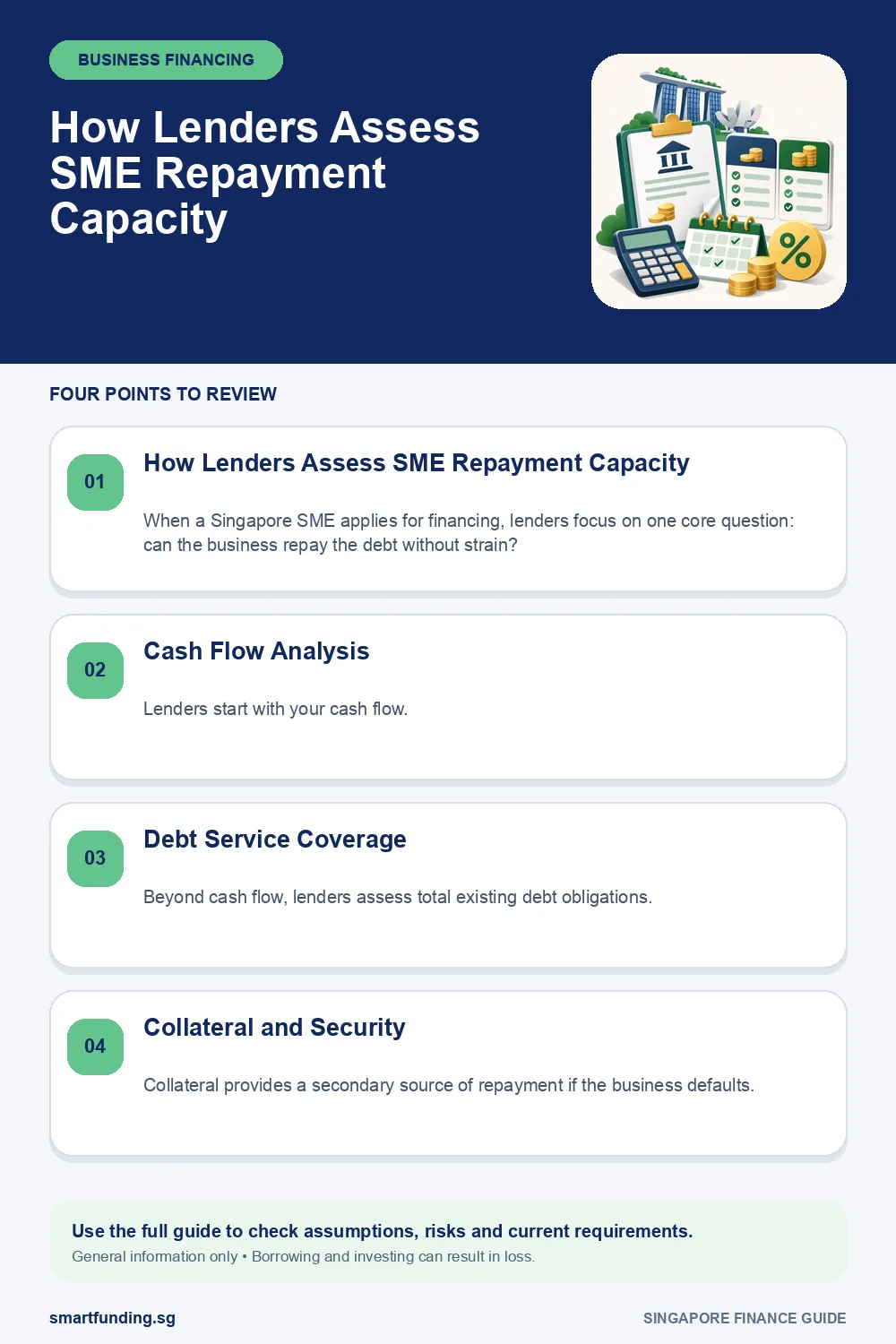
When a Singapore SME applies for financing, lenders focus on one core question: can the business repay the debt without strain? The assessment is a structured evaluation of financial health, business stability, and risk factors. This guide walks through the key areas lenders examine, giving you a clear decision process to prepare your application.
Cash Flow Analysis
Lenders start with your cash flow. They review historical bank statements, profit-and-loss accounts, and projected inflows. The goal is to confirm that operating cash flow consistently exceeds operating expenses plus the proposed debt repayment. Lenders calculate a debt service coverage ratio (DSCR) using this formula:
DSCR = (Net operating income + non-cash charges) / (Total debt service obligations)
A ratio above a certain threshold signals capacity. In Singapore, lenders often scrutinise seasonal patterns—retail businesses may show strong year-end cash flow but weaker mid-year periods. They adjust for these cycles by averaging over several months or requiring a buffer. If your business has irregular cash flow, prepare a projection that shows how you will maintain repayments during lean months.
Debt Service Coverage
Beyond cash flow, lenders assess total existing debt obligations. They sum up all current loan instalments, credit card payments, and any committed financing. Then they compare this total with your net income after operating costs. The total debt service ratio (TDSR) is:
TDSR = (Total monthly debt obligations) / (Gross monthly income)
A high TDSR indicates that a large portion of income already goes to debt, leaving little room for new repayments. In Singapore, lenders may also consider personal guarantees from directors, which can bring personal debt into the picture. To improve your TDSR, reduce existing debt or extend repayment terms before applying.
Collateral and Security
Collateral provides a secondary source of repayment if the business defaults. Lenders evaluate the quality, liquidity, and value of assets offered. Common collateral includes property, equipment, inventory, or trade receivables. The loan-to-value ratio (LTV) is key:
LTV = (Loan amount) / (Appraised value of collateral)
A lower LTV gives the lender more protection. In Singapore, property collateral is often preferred because it is easier to value and liquidate. However, lenders also accept other assets, especially under schemes like the Enterprise Financing Scheme (EFS) administered by Enterprise Singapore. Note that scheme details can change—always verify current terms at the Enterprise Singapore website. Collateral does not replace the need for strong cash flow; it only reduces the lender’s risk.
Industry and Business Risk
Lenders assess the industry your SME operates in. They look at market trends, regulatory environment, and competitive pressures. For example, a food-and-beverage business in Singapore faces high rent and labour costs, while a tech firm may have lower fixed costs but higher customer concentration risk. Lenders also evaluate your business’s track record, management experience, and customer diversification. A single large customer can be a red flag. To mitigate this, show a list of top customers and their share of revenue. If your industry is cyclical or heavily regulated, explain how you manage those risks.
Financial Statements and Projections
Lenders require up-to-date financial statements—usually profit and loss, balance sheet, and cash flow statement for the last two to three years. They also request projections for the loan period. Key metrics include:
- Gross profit margin: indicates pricing power and cost control.
- Operating expense ratio: shows how efficiently you run the business.
- Net profit margin: reveals overall profitability.
Lenders compare these against industry benchmarks. In Singapore, you can find relevant benchmarks from the Singapore Department of Statistics or industry associations. If your margins are below average, be ready to explain why and how the loan will improve them. Projections should be realistic and based on historical data, not optimistic assumptions.
Frequently asked questions
How does my personal credit score affect the application?
In Singapore, lenders often review the personal credit report of business owners, especially for sole proprietorships and partnerships. A poor personal score can reduce the chance of approval or increase pricing. Check your credit report with the Credit Bureau of Singapore (CBS) before applying.
What if my business has a short operating history?
Lenders typically prefer at least two years of operating history. If your SME is younger, you may still qualify by providing strong collateral, a personal guarantee, or a detailed business plan with conservative projections. Some government-assisted schemes may have lower history requirements—verify current criteria at the Enterprise Singapore website.
Can I reapply if my application is declined?
Yes, but first understand why it was declined. Common reasons include weak cash flow, high existing debt, or insufficient collateral. Address those issues—improve cash flow, reduce debt, or offer additional security—before reapplying. Rushing a new application without changes is unlikely to succeed.
For a broader overview of financing options, see our financing options guide. Before applying, consider the seven key factors for SME financing. When ready, you can start your application here.
Borrowing involves risk. If you cannot meet repayments, you may lose collateral and damage your credit. Always assess whether your business can afford the debt before proceeding. For the latest on schemes, regulations, or tax implications, consult official sources such as the Monetary Authority of Singapore (MAS), Enterprise Singapore, ACRA, or IRAS.