SmartFunding insights
A Practical Business Borrowing Checklist for SMEs
A practical checklist for Singapore SMEs evaluating business loans, covering purpose, affordability, terms, and risks without generic hype.
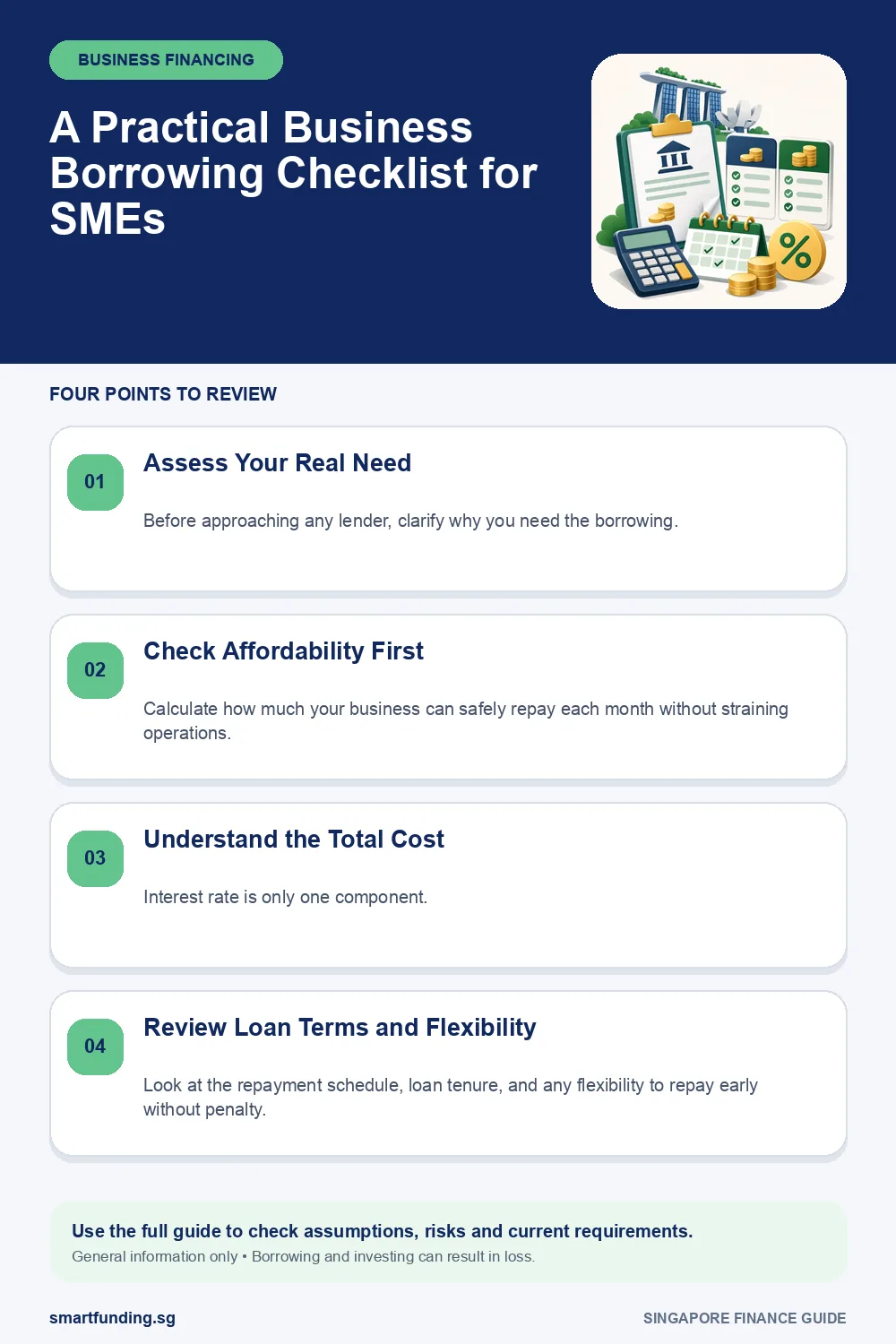
Assess Your Real Need
Before approaching any lender, clarify why you need the borrowing. Common valid reasons include bridging a temporary cash flow gap, funding inventory for a peak season, or purchasing equipment that will generate measurable returns. Avoid borrowing for speculative purposes or to cover persistent operating losses. A clear purpose helps you choose the right product and amount. For a structured overview of available options, see our guide to /financing-options/.
Check Affordability First
Calculate how much your business can safely repay each month without straining operations. Use realistic revenue projections, not optimistic ones. Factor in existing obligations, seasonal dips, and a buffer for unexpected costs. Remember that borrowing costs money – interest and fees reduce your net profit. If the repayment would leave you with insufficient working capital, the loan is likely too large. Always assess the risk of loss before committing. For a deeper look at what to evaluate, read our article on /sme-financing-7-things-to-consider-first/.
Understand the Total Cost
Interest rate is only one component. Ask for a complete breakdown of fees: processing fees, early repayment penalties, late payment charges, and any compulsory insurance. Compare the effective interest rate (EIR) across lenders, as it reflects the true annual cost including most fees. In Singapore, lenders must quote the EIR, but always confirm what is included. Do not assume that a low headline rate means a cheap loan. Verify all terms in writing before signing.
Review Loan Terms and Flexibility
Look at the repayment schedule, loan tenure, and any flexibility to repay early without penalty. A longer tenure reduces monthly payments but increases total interest. A shorter tenure costs less overall but requires higher monthly cash flow. Check whether the loan is secured or unsecured – secured loans may offer lower rates but put your assets at risk. Ensure the terms align with your cash flow cycle. If your business is seasonal, a lump-sum repayment at the end may be more suitable than monthly instalments.
Prepare Your Documentation
Lenders typically require financial statements, bank statements, proof of business registration, and tax returns. For Singapore SMEs, ACRA-registered entities should have their latest annual returns and financial statements ready. Have a clear explanation of how the funds will be used and how you plan to repay. Incomplete or inconsistent documentation can delay approval or lead to rejection. Organise your records before you apply. For a step-by-step process to submit an application, visit our /borrow/ page.
Verify Lender Credentials and Regulations
Only borrow from licensed moneylenders or financial institutions regulated by the Monetary Authority of Singapore (MAS). Check the MAS Register of Representatives and the list of licensed moneylenders. Be wary of unlicensed lenders offering instant approval or guaranteed rates. Note that all regulations, licensing requirements, and tax treatments can change. Verify current rules at the relevant official source – for licensing, check MAS; for tax implications, refer to IRAS; for business registration, consult ACRA. Enterprise Singapore also provides resources for SME financing schemes, but scheme details may be updated.
Compare Multiple Options
Do not accept the first offer. Approach at least two or three lenders – banks, finance companies, and peer-to-peer platforms. Compare not only the EIR but also the loan amount, tenure, and flexibility. Some lenders specialise in certain industries or loan sizes. Use a loan calculator to estimate total repayment under different scenarios. Remember that the cheapest option may not be the best if it lacks flexibility or comes with hidden conditions. Take your time to evaluate each proposal carefully.
Read the Fine Print
Before signing, read every clause in the loan agreement. Pay special attention to: default interest rates, cross-default provisions, personal guarantees, and any clause that allows the lender to demand full repayment early. Understand what happens if you miss a payment. If anything is unclear, ask for clarification or seek independent legal advice. A signed contract is binding, and disputes can be costly. Do not rely on verbal promises – ensure all terms are in the document.
Frequently asked questions
What documents do Singapore SMEs typically need for a business loan application?
Most lenders require ACRA business registration, recent financial statements (audited if applicable), bank statements for the last six months, and tax returns. Additional documents may include a list of debtors, contracts with major customers, or a business plan. Requirements vary by lender and loan type. Always check the specific list before applying. For current guidelines, refer to Enterprise Singapore or your lender’s website.
How does a personal guarantee affect my liability?
A personal guarantee makes you personally liable for the loan if the business cannot repay. This means the lender can pursue your personal assets, such as your home or savings. Many SME loans in Singapore require a personal guarantee from directors. Assess your personal financial situation before agreeing. Consider whether the risk of loss is acceptable. There is no guaranteed protection, so understand the full extent of your obligation.
Can I repay a business loan early without penalty?
Some lenders allow early repayment but may charge a penalty fee, typically a percentage of the outstanding amount or a fixed sum. Others prohibit early repayment entirely. Check the loan agreement for the specific terms. If flexibility is important, ask the lender before signing. In Singapore, early repayment penalties are common, but terms vary. Always confirm in writing and factor this into your decision.
Note: All schemes, tax treatments, regulations, and licensing details mentioned here can change. Always verify current information at the relevant official source – MAS, Enterprise Singapore, ACRA, or IRAS – as applicable. Borrowing involves risk and can result in financial loss. Assess your business’s ability to repay before taking any loan.