SmartFunding insights
Bank Loans and Alternative Business Finance Compared
Compare bank loans and alternative business finance in Singapore. A practical decision process for SMEs, covering costs, speed, and risk.
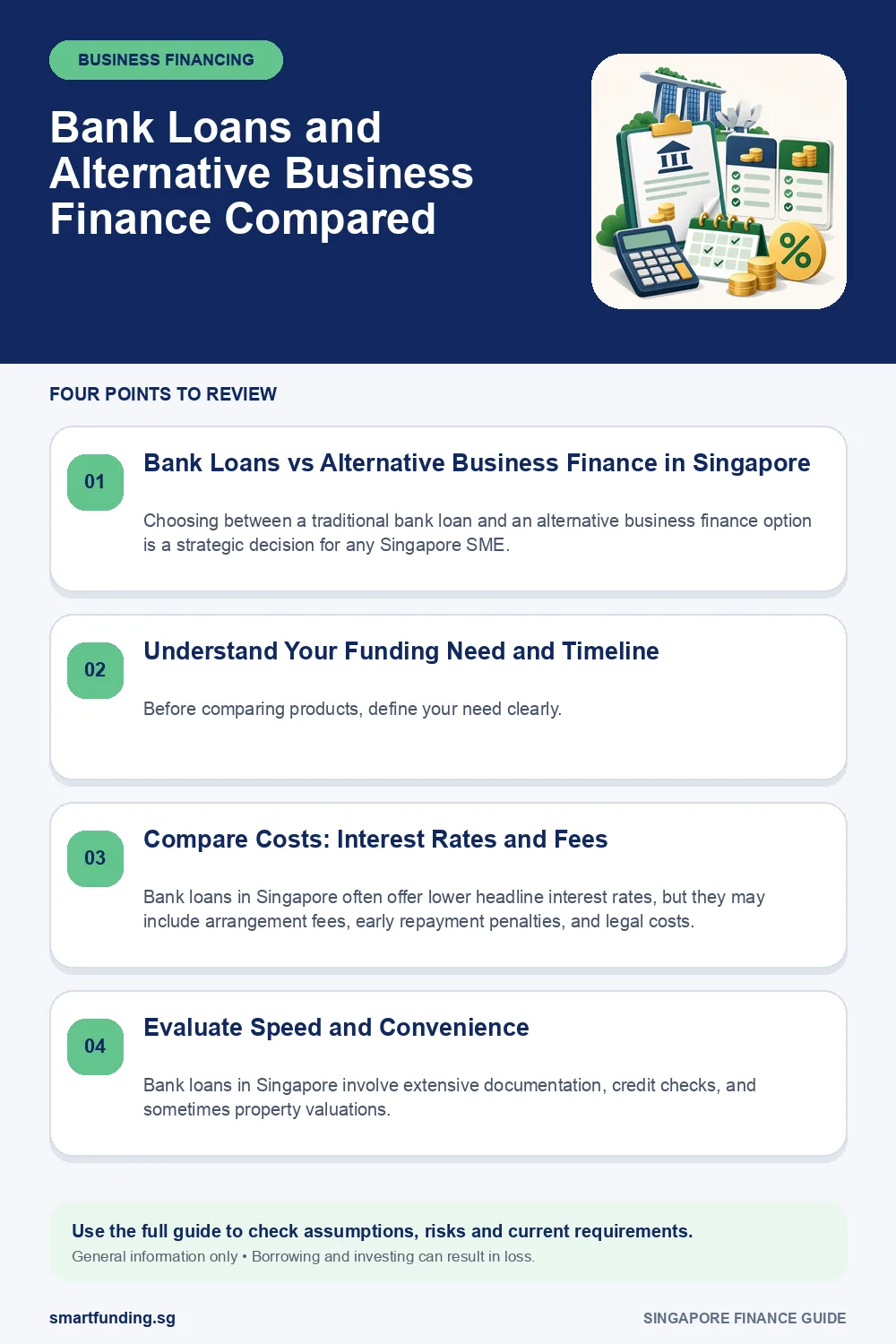
Bank Loans vs Alternative Business Finance in Singapore
Choosing between a traditional bank loan and an alternative business finance option is a strategic decision for any Singapore SME. Each path offers distinct trade-offs in cost, speed, and flexibility. This guide provides a practical decision process, focusing on how Singapore’s regulatory and business environment affects your choice.
Understand Your Funding Need and Timeline
Before comparing products, define your need clearly. Are you covering a short-term cash flow gap, purchasing equipment, or funding growth? The timeline matters: bank loans typically require weeks for approval and disbursement, while alternative lenders may decide within days. In Singapore, where business cycles can be fast, speed may be critical for seizing opportunities or managing urgent obligations.
Decision step: Write down the amount needed, the purpose, and the earliest date you require the funds. This will guide your comparison.
Compare Costs: Interest Rates and Fees
Bank loans in Singapore often offer lower headline interest rates, but they may include arrangement fees, early repayment penalties, and legal costs. Alternative financing—such as invoice financing, peer-to-peer lending, or merchant cash advance—may have higher effective costs but fewer hidden charges.
Key variables to compare: - Annualised cost (interest rate plus fees expressed as a yearly rate) - Processing fee (a percentage of the loan amount) - Early repayment fee (if you pay off the loan early) - Collateral requirement (bank loans often require property or other assets)
For example, a bank loan with a low interest rate but a high processing fee may be more expensive than an alternative loan with a slightly higher rate but no fees. Always calculate the total cost over the loan term.
Evaluate Speed and Convenience
Bank loans in Singapore involve extensive documentation, credit checks, and sometimes property valuations. Alternative lenders use digital platforms and data-driven underwriting, which can approve applications within hours. This speed is valuable for emergency working capital or time-sensitive deals.
Decision step: If you need funds within a week, alternative finance is likely more suitable. If you can wait and have strong financials, a bank loan may offer lower cost.
Assess Collateral and Personal Guarantee Requirements
Singapore banks typically require collateral—such as property, fixed deposits, or personal guarantees from directors—for most business loans. This increases the risk to your personal assets. Alternative lenders often offer unsecured loans, invoice financing (using your unpaid invoices as security), or revenue-based financing (repayment as a percentage of sales).
Risk consideration: If you cannot afford to lose the collateral, or if you want to limit personal liability, an unsecured alternative may be better. However, unsecured loans often have higher interest rates.
Consider Your Business Profile and Credit History
Banks in Singapore rely heavily on the company’s financial statements, tax filings, and the directors’ personal credit scores. Startups or SMEs with less than two years of operating history may find it difficult to qualify. Alternative lenders use different data—such as transaction history, e-commerce sales, or invoice volume—making them more accessible for younger or unconventional businesses.
Decision step: If your business has a strong track record and good credit, bank loans are worth exploring. If you are new or have limited credit history, alternative finance may be your only viable option.
Understand Regulatory and Tax Implications
In Singapore, bank loans are regulated by the Monetary Authority of Singapore (MAS). Alternative lenders may also be regulated if they are licensed under the Moneylenders Act or other frameworks. Some forms of alternative finance, such as peer-to-peer lending, are subject to specific MAS regulations.
Tax treatment also differs. Interest on business loans is generally tax-deductible, but fees may be treated differently. Verify current rules with IRAS or a qualified tax advisor. For any scheme or regulation, check the relevant official source—such as MAS, Enterprise Singapore, ACRA, or IRAS—as details can change.
Important: Borrowing can lead to loss if you cannot repay. Always assess affordability and risk before committing.
Make Your Decision Using a Simple Framework
- Define need: Amount, purpose, timeline.
- Check eligibility: Do you meet bank criteria? If not, explore alternatives.
- Compare total cost: Use the variables above.
- Assess risk: Can you afford to lose collateral or pay higher interest?
- Verify regulations: Confirm current rules at official sources.
- Choose: Select the option that balances cost, speed, and risk for your specific situation.
For more details, explore financing options for Singapore SMEs, read seven things to consider before applying for SME financing, or learn how to borrow responsibly.
Frequently asked questions
What is the main difference between bank loans and alternative business finance in Singapore?
Bank loans typically offer lower interest rates but require collateral, a strong credit history, and longer processing times. Alternative finance provides faster access, less stringent requirements, and often unsecured loans, but at a higher cost. Your choice depends on your urgency, credit profile, and risk tolerance.
How do I know if I qualify for a bank loan in Singapore?
Qualification depends on factors such as your company’s trading history, profitability, credit score, and available collateral. Banks usually require at least two years of financial statements and a good personal credit record. The best way to know is to consult with a bank or a business advisor. Check current guidelines on MAS’s website.
Are alternative lenders regulated in Singapore?
Yes, many alternative lenders are regulated by MAS under the Moneylenders Act or other frameworks. Peer-to-peer lending platforms must hold a capital markets services license. Always verify the lender’s license status on MAS’s register before borrowing. Regulations can change, so confirm with the official source.