SmartFunding insights
How to Match Business Funding to Its Purpose
Match business funding to its purpose with a practical decision process. Avoid costly mismatches by assessing need, cost, risk and repayment fit.
Assess the funding purpose first
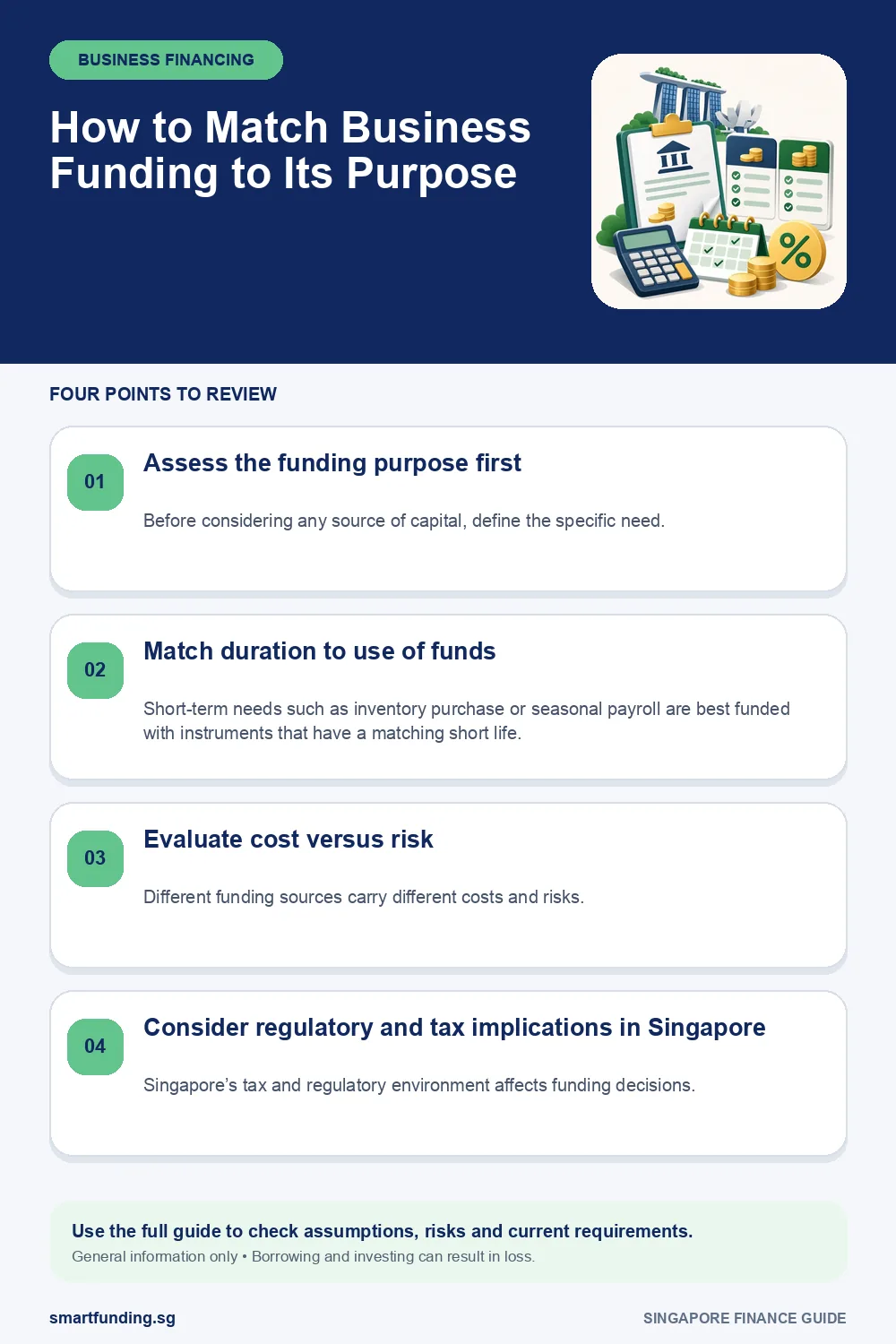
Before considering any source of capital, define the specific need. Is it for working capital to cover short-term cash flow gaps, purchasing equipment with a multi-year life, funding a growth opportunity that may or may not materialise, or refinancing existing debt? The purpose determines the suitable structure. A mismatch — for example using short-term debt for long-term assets — can create repayment pressure or unnecessary cost. Write down the amount needed, the expected timing of use and the likely source of repayment. This clarity is the foundation of the matching process.
Match duration to use of funds
Short-term needs such as inventory purchase or seasonal payroll are best funded with instruments that have a matching short life. Trade finance, invoice factoring or a working capital line of credit can align with cash conversion cycles. Long-term investments like machinery, renovation or technology upgrades should be financed with term loans or equipment financing that spreads cost over the asset’s useful life. A common mistake is using a revolving credit facility for a fixed asset purchase, which can lead to balloon payments or frequent renewals. Consider the financing options available and match the tenor to the asset’s depreciation or the project’s payback period.
Evaluate cost versus risk
Different funding sources carry different costs and risks. Debt requires regular interest and principal payments regardless of business performance. Equity or quasi-equity instruments may be more expensive in terms of dilution but offer flexibility when cash flow is uncertain. For debt, consider the effective interest rate, fees, collateral requirements and personal guarantees. For equity, consider the control and reporting implications. There is no single best source. The right choice depends on how much risk the business can bear and how predictable the cash flow is. Always assess affordability: borrowing that cannot be serviced from operating cash flow can lead to distress. Investing in a business with borrowed money also carries loss risk.
Consider regulatory and tax implications in Singapore
Singapore’s tax and regulatory environment affects funding decisions. Interest expense on business loans is generally deductible for corporate income tax, but only if the funds are used for income-producing purposes. Verify current rules with IRAS. For equity funding, the tax treatment of dividends and capital gains differs from interest. Certain grants and schemes from Enterprise Singapore may provide co-funding or risk-sharing for specific purposes such as innovation, internationalisation or capability development. These are not loans but may have compliance conditions. Always check the latest terms at the relevant official source. Licensing requirements may apply if the funding involves securities or collective investment schemes — consult ACRA or MAS guidelines. Do not assume any scheme remains unchanged.
Review your business’s readiness
Before approaching any funding source, assess your business’s financial health and documentation. Lenders and investors typically review cash flow history, profitability, debt service coverage ratio, credit score and collateral. For debt, a strong repayment track record improves terms. For equity, a clear growth story and exit plan matter. If the business lacks these, consider SME financing 7 things to consider first to strengthen the application. Be realistic about what the business can support. A funding mismatch often arises from over-optimism about future revenue. Stress-test your projections with a downside scenario.
Match funding type to business stage
Early-stage businesses with limited track record may struggle to access unsecured bank loans. They might consider convertible notes, venture debt or grants. Growth-stage businesses with consistent revenue can access term loans or lines of credit. Mature businesses with assets may use asset-based lending or secured bonds. The stage also affects the cost of capital. Younger businesses typically pay higher rates or give up more equity. Do not assume that all funding sources are available to every business. Check eligibility criteria directly with providers. If you are exploring debt, you can borrow after understanding the terms. Always compare multiple offers and read the fine print.
Monitor and adjust after funding
Once funding is in place, monitor the use of funds against the original purpose. If the purpose changes — for example, using equipment loan proceeds for working capital — the risk profile shifts. Track repayment schedules and maintain communication with the lender or investor. If the business faces difficulty, early engagement can open restructuring options. Avoid taking on new debt to service existing debt unless it is a deliberate refinancing that improves terms. Regularly review whether the funding structure still fits the business’s current needs and market conditions.
Frequently asked questions
What is the most common mistake when matching funding to purpose?
Using short-term debt for long-term assets. This creates a mismatch where the repayment schedule does not align with the cash flow generated by the asset, often leading to refinancing pressure or default.
How do Singapore-specific grants affect funding decisions?
Grants from Enterprise Singapore or other agencies can reduce the amount of debt or equity needed for specific projects. However, they come with compliance requirements and may not cover all costs. Always verify current terms at the official source and factor in the application timeline.
Should I always choose the cheapest funding option?
No. The cheapest option in terms of interest rate may have restrictive covenants, short repayment terms or high collateral requirements. The best option is one that matches the purpose, duration and risk profile of the use of funds, while remaining affordable for the business.